Some suspicion may arise at this point that the land ethic is ultimately grounded in human interests, not in those of nonhuman natural entities. Just as we might prefer a sound and attractive house to one in the opposite condition so the "goodness" of a whole, stable, and beautiful environment seems rather to be of the instrumental, not the autochthonous, variety. The question of ultimate value is a very sticky one for environmental as well as for all ethics and cannot be fully addressed here. It is my view that there can be no value apart from an evaluator, that all value is as it were in the eye of the beholder. The value that is attributed to the ecosystem, therefore, is humanly dependent or (allowing that other living things may take a certain delight in the well-being of the whole of things, or that the gods may) at least dependent upon some variety of morally and aesthetically sensitive consciousness. Granting this, however, there is a further, very crucial distinction to be drawn. It is possible that while things may only have value because we (or someone) values them, they may nonetheless be valued for themselves as well as for the contribution they might make to the realization of our (or someone's) interests. Children are valued for themselves by most parents. Money, on the other hand, has only an instrumental or indirect value. Which sort of value has the health of the biotic community and its members severally for Leopold and the land ethic? It is especially difficult to separate these two general sorts of value, the one of moral significance, the other merely selfish, when something that may be valued in both ways at once is the subject of consideration. Are pets, for example, well-treated, like children, for the sake of themselves, or, like mechanical appliances, because of the sort of services they provide their owners? Is a healthy biotic community something we value because we are so utterly and (to the biologically well-informed) so obviously dependent upon it not only for our happiness but for our very survival, or may we also perceive it disinterestedly as having an independent worth? Leopold insists upon a noninstrumental value for the biotic community and mutatis mutandis for its constituents. According to Leopold, collective enlightened self-interest on the part of human beings does not go far enough; the land ethic in his opinion (and no doubt this reflects his own moral intuitions) requires "love, respect, and admiration for land, and a high regard for its value." The land ethic, in Leopold's view, creates "obligations over and above self-interest." And, "obligations have no meaning without conscience, and the problem we face is the extension of the social conscience from people to land." If, in other words, any genuine ethic is possible, if it is possible to value people for the sake of themselves, then it is equally possible to value land in the same way.
(J. Baird Callicott, "Animal Liberation: A Triangular Affair," Environmental Ethics 2 [winter 1980]: 311-38, at 325-6 [italics in original; footnote omitted])
Note from KBJ: I quote this long passage because it shows, in the context of environmental ethics, how one can distinguish between intrinsic and extrinsic value while being a value subjectivist. There are two distinctions that should not be conflated (but that often are). The first is between two types of value: objective and subjective. Objective value inheres in the world outside of subjects and would exist without them; subjective value is conferred by subjects (such as human beings) and would not exist without them. The second distinction is between two ways of valuing: intrinsically and extrinsically. To value a thing intrinsically is to value it for its own sake, as an end in itself, because of the kind of thing it is (i.e., because of its properties). To value a thing extrinsically is to value it for the sake of something else one values, as either a part of or a means to that other thing (i.e., because of its relations). Callicott is a value subjectivist, but he values land ("the biotic community") intrinsically as well as extrinsically. I'm a value subjectivist, but I value land only extrinsically.
20 June 2008


17 June 2008
Jan Narveson on Moral Vegetarianism
What the utilitarian who defends human carnivorousness must say, then, is something like this: that the amount of pleasure which humans derive per pound of animal flesh exceeds the amount of discomfort and pain per pound which are inflicted on the animals in the process, all things taken into account. Is this plausible? I am not persuaded that it isn't, as far as it goes. But it should be noted that this is only a leading premise, as it were, of a complete argument on the issue. For we must realize that the question is whether this justifies the eating of animals in comparison with alternatives. And there are two relevant kinds of alternatives here: one is treating the animals better before we eat them, the only disadvantage of which is that it would make meat considerably more expensive. And the other is taking up vegetarianism. Utilitarians persuaded of the leading premise here should, I think, be willing to pay the higher prices, and to plump for protections of animals of the kind in question. But what about the vegetarian alternative? Here what one needs to do is calculate the pleasure, interest, satisfaction, etc., by which animal diets exceed vegetable diets for us. And most of us, of course, just don't know about this. How do we know but what, once we got used to a vegetarian diet, we would find that our pleasure is scarcely diminished at all? Human ingenuity is great, and undoubtedly a skilful vegetarian cook can come up with quite a panoply of delicious dishes. It would remain true, of course, that the vegetarian diet is more limited, since every pleasure available to the vegetarian is also available to the carnivore (not counting the moral satisfactions involved, of course—which would be question-begging), plus more which are not available to the vegetarian so long as he remains one. But unless we attach a high intrinsic value to greater aesthetic variety in our diet (and some of us do; but most of us, perhaps, do not), this won't be a decisive consideration.
Once one bears in mind that it is this comparative assessment that is required, then it seems to me there will be a strong case (1) for Humane Slaughter, and humane treatment prior to slaughter, and (2) insofar as really painless and comfortable animal-raising is not attained or attainable, giving vegetarianism a try, at least. In present circumstances, the following would seem to be indicated. Depending on the time and energy available, utilitarians persuaded of the foregoing should try a period of vegetarianism, at least, in order to see how they get on, and perhaps as a weapon in the form of boycotting such meat and dairy products as are produced in excessive disregard for the comfort of the animals in question: a much milder program than the one Singer and Regan call for, but one giving more to the animals than we usually do, and leaving our consciences rather less comfortable than they perhaps typically are.
(Jan Narveson, "Animal Rights," Canadian Journal of Philosophy 7 [March 1977]: 161-78, at 173-4 [italics in original])
From Today's New York Times
To the Editor:
Re “South Koreans Assail U.S. Pact, Shaking Leader” (front page, June 11), about the large demonstrations in Seoul:
In October 1989, six Korean college students broke into the American ambassador’s residence in Seoul and did $35,000 worth of damage before being arrested by the Korean police. I was the ambassador, and the issue was beef.
Modern Korean society still has deep roots in its agricultural traditions, and Koreans can get very defensive about any issue that seems to threaten the livelihood of “grandpa and grandma” back on the farm, even if this causes them to pay twice as much for inefficiently produced Korean beef as they would for foreign imports.
This is a delicate issue that needs to be handled with sensitivity by leaders in Seoul and Washington, so that the question of beef does not derail the important free-trade agreement with South Korea being considered by Congress.
This issue also needs to be placed in a broader context. South Korea is a tremendous ally of the United States. It sent more than 300,000 troops to help us in Vietnam, was a quick and generous supporter of Desert Storm in 1991, and for several years had the third-largest deployment of troops in Iraq, following our invasion of that country five years ago.
Without our strong alliance with South Korea, our influence in Asia would be vastly diminished. Let us keep that fact clearly in mind, as we deal with the fractious beef issue.
Donald Gregg
Chairman, Korea Society
Armonk, N.Y., June 12, 2008
Note from KBJ: If South Koreans were truly concerned with their health, they wouldn't be eating beef in the first place.
13 June 2008
Meat-Eating and the Environment
Vegetarianism is overdetermined, in the sense that there is more than one sufficient reason for being a vegetarian. Here is one determination of it.
12 June 2008
11 June 2008
Joel Feinberg (1926-2004) on Animal Rights
So far McCloskey is on solid ground, but one can quarrel with his denial that any animals but humans have interests. I should think that the trustee of funds willed to a dog or cat is more than a mere custodian of the animal he protects. Rather his job is to look out for the interests of the animal and make sure no one denies it its due. The animal itself is the beneficiary of his dutiful services. Many of the higher animals at least have appetites, conative urges, and rudimentary purposes, the integrated satisfaction of which constitutes their welfare or good. We can, of course, with consistency treat animals as mere pests and deny that they have any rights; for most animals, especially those of the lower orders, we have no choice but to do so. But it seems to me, nevertheless, that in general, animals are among the sorts of beings of whom rights can meaningfully be predicated and denied.
Now, if a person agrees with the conclusion of the argument thus far, that animals are the sorts of beings that can have rights, and further, if he accepts the moral judgment that we ought to be kind to animals, only one further premise is needed to yield the conclusion that some animals do in fact have rights. We must now ask ourselves for whose sake ought we to treat (some) animals with consideration and humaneness? If we conceive our duty to be one of obedience to authority, or to one's own conscience merely, or one of consideration for tender human sensibilities only, then we might still deny that animals have rights, even though we admit that they are the kinds of beings that can have rights. But if we hold not only that we ought to treat animals humanely but also that we should do so for the animals' own sake, that such treatment is something we owe animals as their due, something that can be claimed for them, something the withholding of which would be an injustice and a wrong, and not merely a harm, then it follows that we do ascribe rights to animals. I suspect that the moral judgments most of us make about animals do pass these phenomenological tests, so that most of us do believe that animals have rights, but are reluctant to say so because of the conceptual confusions about the notion of a right that I have attempted to dispel above.
(Joel Feinberg, "The Rights of Animals and Unborn Generations," chap. 8 in his Rights, Justice, and the Bounds of Liberty: Essays in Social Philosophy [Princeton: Princeton University Press, 1980], 159-84, at 166-7 [italics in original] [essay first published in 1974])
09 June 2008
R. G. Frey on Applied Philosophy
I support wholeheartedly the application of philosophy to practical issues; but it is as well to be aware at the outset of the form which the philosopher's contribution to these issues takes. It is, as R. M. Hare has impressed upon me, simply this: philosophy is concerned with testing arguments for soundness, and the occupation of the philosopher is to carry out this testing. To this end, he deploys the tools and canons of logic on behalf of accuracy in argument, explores questions of meaning, implication, presupposition, derivation, relation, compatibility, etc., pries into and generates examples and counter-examples, both realistic and hypothetical, and so on. One but only one of the tools he deploys in this task is the analysis of those concepts in which the arguments he is testing are set out; analysis is not, however, an alternative view of what the philosopher is about, in some way competing with his assessment of arguments. By contrast, though he can and doubtless should concern himself with and even soak himself in the factual material pertaining to the specific arguments under his gaze, further increases in this factual material and knowledge are not part of the philosopher's task as such.
(R. G. Frey, Interests and Rights: The Case Against Animals [Oxford: Clarendon Press, 1980], 2)
Note from KBJ: Frey is right that the philosopher, as such, has no factual expertise. He should have added that the same is true of evaluative expertise. That X is a philosopher does not give X's values any greater weight. Why should it? Where in my formal study to be a philosopher did I learn correct values? Philosophy is a formal enterprise. It can tell people that they cannot believe both p and q. It cannot tell people which of the propositions, if either, to believe. It can tell people that if they believe r, they must also believe s. It cannot tell people to believe r. The only leverage a philosopher has is the principle of noncontradiction. That may not seem like a lot, but it is.
Note 2 from KBJ: Frey says that "philosophy is concerned with testing arguments for soundness." A sound argument is a valid argument with true premises. A valid argument is an argument in which the truth of the premises is incompatible with the falsity of the conclusion. I hope you can see that Frey meant "validity" rather than "soundness." The philosopher is concerned not with the truth of an argument's premises, but with whether they entail the conclusion. There is one class of truths concerning which the philosopher, as such, has expertise, namely, necessary truths. The philosopher, as such, has no expertise concerning contingent truths.
Note 3 from KBJ: The following propositions are consistent:
1. Keith is a philosopher.If you understood what I said in my previous notes, you will see why these propositions are consistent.
2. Keith makes value judgments.
3. Philosophers, as such, do not make value judgments.
08 June 2008
John Benson on Peter Singer's Argument
Singer's supreme principle is that all sentient beings are entitled to equal consideration of their interests. A being has interests if it is capable of suffering and enjoyment. This capacity is a prerequisite for having interests at all, and the actual interests that a being has are determined by the particular kinds and degrees of suffering and enjoyment of which it is capable. Equal interests must be equally respected, without regard to the species of the creatures whose interests they are. One may treat two creatures differently because one is less sensitive than the other to some kind of suffering, but two equally sensitive creatures may not be treated differently merely because they belong to different species. If my dog and I both have headaches then the dog should have the one available aspirin if it has the worse headache. To treat the dog's pain as less important because it is a dog not a man is speciesism (a nasty word for a nasty thing).
(John Benson, "Duty and the Beast," Philosophy 53 [October 1978]: 529-49, at 530)
(John Benson, "Duty and the Beast," Philosophy 53 [October 1978]: 529-49, at 530)
06 June 2008
Thomas Hobbes (1588-1679) on Deliberation
When in the mind of man, Appetites, and Aversions, Hopes, and Feares, concerning one and the same thing, arise alternately; and divers good and evill consequences of the doing, or omitting the thing propounded, come successively into our thoughts; so that sometimes we have an Appetite to it; sometimes an Aversion from it; sometimes Hope to be able to do it; sometimes Despaire, or Feare to attempt it; the whole summe of Desires, Aversions, Hopes and Fears, continued till the thing be either done, or thought impossible, is that we call DELIBERATION.
Therefore of things past, there is no Deliberation; because manifestly impossible to be changed: nor of things known to be impossible, or thought so; because men know, or think such Deliberation vain. But of things impossible, which we think possible, we may Deliberate; not knowing it is in vain. And it is called Deliberation; because it is a putting an end to the Liberty we had of doing, or omitting, according to our own Appetite, or Aversion.
This alternate Succession of Appetites, Aversions, Hopes and Fears, is no lesse in other living Creatures then [sic] in Man: and therefore Beasts also Deliberate.
Every Deliberation is then sayd to End, when that whereof they Deliberate, is either done, or thought impossible; because till then wee retain the liberty of doing, or omitting, according to our Appetite, or Aversion.
In Deliberation, the last Appetite, or Aversion, immediately adhaering to the action, or to the omission thereof, is that wee call the WILL; the Act, (not the faculty,) of Willing. And Beasts that have Deliberation, must necessarily also have Will. The Definition of the Will, given commonly by the Schooles, that it is a Rationall Appetite, is not good. For if it were, then could there be no Voluntary Act against Reason. For a Voluntary Act is that, which proceedeth from the Will, and no other. But if in stead of a Rationall Appetite, we shall say an Appetite resulting from a precedent Deliberation, then the Definition is the same that I have given here. Will therefore is the last Appetite in Deliberating.
(Thomas Hobbes, Leviathan, rev. student ed., ed. Richard Tuck, Cambridge Texts in the History of Political Thought, ed. Raymond Geuss and Quentin Skinner [Cambridge: Cambridge University Press, 1996], chap. 6, pp. 44-5 [italics in original] [first published in 1651])
05 June 2008
Vegan Goes Mainstream!
Oprah Winfrey goes vegan for 21 days. See both Oprah's blog and this story for details.
On Day 1 of her 21-day experiment with veganism, Oprah aptly asked: "How can you say you're trying to spiritually evolve, without even a thought about what happens to the animals whose lives are sacrificed in the name of gluttony?"
On Day 2, Oprah reported: "Wow, wow, wow! I never imagined meatless meals could be so satisfying. I had been focused on what I had to give up—sugar, gluten, alcohol, meat, chicken, fish, eggs, cheese. 'What's left?' I thought. Apparently a lot. I can honestly say every meal was a surprise and a delight, beginning with breakfast—strawberry rhubarb wheat-free crepes."
On Day 4, Oprah wrote: "I just cleaned my dinner plate, down to the last grain of brown rice left under my oh-so-delicious seasoned soy 'chicken.' I can not believe how tasty, spicy and wonderful it all was. I'm ever more surprised at how I don't miss anything and feel so satisfied at every meal."
Oprah is discovering just how delicious a heart-healthful, cruelty-free, environmentally-friendly vegan diet can be. She is experiencing firsthand the synergistic benefits that come from a vegan lifestyle. Why not join Oprah in her experiment? Try a cruelty-free vegan diet for 21 days and see how you feel. If you're like most people, you'll feel better physically, spiritually, and ethically, almost immediately.
From Today's New York Times
To the Editor:
Re “Monkeys Think, Moving Artificial Arm as Own” (front page, May 29):
The brain really is a fascinating organ. I was also intrigued to read that “in previous studies, researchers showed that humans who had been paralyzed for years could learn to control a cursor on a computer screen with their brain waves.”
So why were the monkeys used? It seems to me that the most fruitful route to go in this sort of research that could have very important implications for humans with severe motor deficits would be to study humans and leave the monkeys alone.
Marc Bekoff
Boulder, Colo., May 29, 2008
The writer is in the department of ecology and evolutionary biology, University of Colorado.
04 June 2008
From the Mailbag
Hello,
I am a volunteer for 1-800-Save-A-Pet.com, which is North America's largest non-profit pet adoption website, and I'm trying to get the word out about homeless pet adoption.
I am looking at your site and thought you might like to add a link somewhere to 1-800-Save-A-Pet.com. Save-A-Pet is a totally free service where 5,000 animal shelters have 80,000 pets listed who need homes today, and a link from your website would be a great way to help get the word out!
Please let me know if this is possible and thank you so much!
Sincerely,
Andrea Rasmussen
03 June 2008
Peter Singer on the Wrongness of Killing Animals
In setting out to write this paper, my intention was to fill a gap in my book Animal Liberation. There I argued that the interests of animals ought to be considered equally with our own interests and that from this equality it follows that we ought to become vegetarian. The argument for vegetarianism is not based on any claim about the wrongness of killing animals—although some careless reviewers read this claim into my book, no doubt because they assumed that any moral argument for vegetarianism must be based on the wrongness of killing. Instead the argument for vegetarianism is based on the suffering that is, and as far as I can see always will be, associated with the rearing and slaughtering of animals on a large scale to feed urban populations. I explicitly avoided taking a position on the wrongness of killing animals, for I wanted the book to reach non-philosophers, and the issue of killing cannot be dealt with briefly and simply.
(Peter Singer, "Killing Humans and Killing Animals," Inquiry 22 [summer 1979]: 145-56, at 145 [italics in original; endnote omitted])
(Peter Singer, "Killing Humans and Killing Animals," Inquiry 22 [summer 1979]: 145-56, at 145 [italics in original; endnote omitted])
02 June 2008
Betty White
Actress and animal activist Betty White is on the Tavis Smiley Show tonight. See here for details.
From Today's New York Times
To the Editor:
I noticed that the sustainability house at Oberlin College enjoys barbecues with burgers and grilled corn.
Is it possible that for all their water-saving tactics, the students have overlooked a way to save huge amounts of water: cutting out beef?
It can take an estimated 2,500 gallons of water to produce one pound of beef. Oberlin students can time showers all they want, but one burger will cost them the equivalent of a 45-minute shower every day for a week!
I don’t necessarily advocate vegetarianism, but those looking to improve the sustainability of their lifestyles should take a look at their diet. Reducing meat consumption, particularly of beef, is one of the simplest and most rewarding things we can do.
Nadia Eghbal
Tübingen, Germany, May 26, 2008
John Rodman on the Paradox of Animal Experimentation
Beneath all else, slumbering but soon to awaken, is the paradox—old as the seventeenth century—intensified by recent studies of animal behavior: certain beasts are "human" enough (similar to man) that experimentation on them seems justified (to man) by the possible benefit to man; yet these same beasts are "inhuman" enough (different from man) that experimentation on them (in ways that would not be allowed on man) is morally permissible. Jane Goodall lamely concludes that chimpanzees should be housed and fed better in the labs.
(John Rodman, "The Dolphin Papers," The North American Review 259 [spring 1974]: 13-26, at 18)
(John Rodman, "The Dolphin Papers," The North American Review 259 [spring 1974]: 13-26, at 18)
30 May 2008
Wolves
Here is a New York Times editorial opinion about the removal of the gray wolf (Canis lupus) from the endangered-species list. The editorial board of the Times is intellectually dishonest, so please don't let this be your only source of information about the delisting. Here, for example, is a news release from the U.S. Fish & Wildlife Service. Here are questions and answers. Here is the management plan of Idaho's Fish and Game Commission.
29 May 2008
Leonard Nelson (1882-1927) on Animal Rights
If we apply the criterion of duty, the question of whether animals have rights can be readily answered: we have merely to ask whether, in considering an action affecting an animal, we could assent to such an action after abstracting from numerical determination. In other words, we have to ask whether we would consent to be used as mere means by another being far superior to us in strength and intelligence. This question answers itself. The fact that man has other beings in his power, and that he is in a position to use them as means to his own ends, is purely fortuitous.
(Leonard Nelson, System of Ethics, trans. Norbert Guterman [New Haven: Yale University Press, 1956], 141 [first published in German in 1932])
(Leonard Nelson, System of Ethics, trans. Norbert Guterman [New Haven: Yale University Press, 1956], 141 [first published in German in 1932])
28 May 2008
Using Animals as Mere Means to Human Ends
How many of you think this experiment is justified? If you think it's justified, would it be justified if the experimental subjects were orphaned children?
From Today's New York Times
To the Editor:
Re “Biotech Company to Auction Chances to Clone a Dog” (news article, May 21):
Cloning animals to “replace” treasured companions is a boondoggle. These beloved animals’ personalities and charming quirks cannot be so easily reproduced. And when one considers that millions of dogs and cats are killed each year in shelters because there are no homes for them, cloning becomes unethical as well.
Kathy Guillermo
Director
Laboratory Investigations Department
People for the Ethical Treatment of Animals
Norfolk, Va., May 21, 2008
27 May 2008
Hampton L. Carson (1852-1929) on the Punishment of Animals
In the open square of the old Norman city of Falaise, in the year 1386, a vast and motley crowd had gathered to witness the execution of a criminal convicted of the crime of murder. Noblemen in armour, proud dames in velvet and feathers, priests in cassock and cowl, falconers with hawks upon their wrists, huntsmen with hounds in leash, aged men with their staves, withered hags with their baskets or reticules, children of all ages and even babes in arms were among the spectators. The prisoner was dressed in a new suit of man's clothes, and was attended by armed men on horseback, while the hangman before mounting the scaffold had provided himself with new gloves and a new rope. As the prisoner had caused the death of a child by mutilating the face and arms to such an extent as to cause a fatal hemorrhage, the town tribunal, or local court, had decreed that the head and legs of the prisoner should be mangled with a knife before the hanging. This was a mediæval application of the lex talionis, or "an eye for an eye and a tooth for a tooth." To impress a recollection of the scene upon the memories of the bystanders an artist was employed to paint a frescoe on the west wall of the transept of the Church of the Holy Trinity in Falaise, and for more than four hundred years that picture could be seen and studied until destroyed in 1820 by the carelessness of a white washer. The criminal was not a human being, but a sow, which had indulged in the evil propensity of eating infants on the street.
(Hampton L. Carson, "The Trial of Animals and Insects: A Little Known Chapter of Mediæval Jurisprudence," Proceedings of the American Philosophical Society 56 [1917]: 410-5, at 410)
(Hampton L. Carson, "The Trial of Animals and Insects: A Little Known Chapter of Mediæval Jurisprudence," Proceedings of the American Philosophical Society 56 [1917]: 410-5, at 410)
25 May 2008
John Passmore (1914-2004) on the Moral Status of Animals
One restriction on the absolutism of man's rule over Nature is now generally accepted: moral philosophers and public opinion agree that it is morally impermissible to be cruel to animals. And by this they mean not only that it is wrong to enjoy torturing animals—which few moralists would ever have wished explicitly to deny, however little emphasis they might have placed on cruelty to animals in their moral teaching—but that it is wrong to cause them to suffer unnecessarily. "The Puritan," Macaulay once wrote with condemnatory intent, "hated bear-baiting, not because it gave pain to the bear, but because it gave pleasure to the spectators." In other words, what they hated—and by no means perversely—was the enjoyment of animal suffering; to the mere fact that the bears suffered as a consequence of human action they were indifferent. That, on the whole, is the Christian tradition. But now the situation has changed; not only cruelty—the enjoyment of animal suffering—but callousness, indifference to animal suffering, not taking it into account in deciding how one ought to act, is morally condemned.
Controversies no doubt remain. But they now turn around the question what is to count as "making animals suffer unnecessarily," whether, for example, vivisection or fox-hunting are, in these terms, morally justifiable. By looking in some detail at the way in which the general moral principle that it is wrong to act callously has gradually won acceptance, we can hope to see revealed, first, how reluctantly Western man has accepted any restriction whatsoever on his supposed right to deal as he pleases with Nature and, secondly, how changes in his moral outlook have nevertheless come about.
(John Passmore, "The Treatment of Animals," Journal of the History of Ideas 36 [April-June 1975]: 195-218, at 195 [italics in original; footnotes omitted])
23 May 2008
From Yesterday's New York Times
To the Editor:
Re “A Disgraceful Farm Bill” (editorial, May 16):
While the farm bill recently approved by Congress deals with enormous agricultural policy issues, it also includes three important provisions to protect animal welfare.
Because the Agriculture Department enforces the Animal Welfare Act, this authorizing bill deals with a broad range of subjects regarding the humane treatment of animals.
The bill contains sweeping new penalties against animal fighting, included after the Michael Vick case revealed the pervasiveness of this crime.
The bill also bans the importation of puppies from foreign puppy mills, and increases penalties for violations of the Animal Welfare Act from $2,500 to $10,000. Enforcement has been inconsistent at best. These new penalties would give the law some much needed teeth.
The Humane Society of the United States and other animal protection organizations support the farm bill because of these achievements for animals. We hope Congress will vote to override the president’s veto.
Wayne Pacelle
President and Chief Executive
The Humane Society of the United States
Washington, May 21, 2008
21 May 2008
Henry S. Salt (1851-1939) on the Fallacious Appeal to Nature
Of the many dense prejudices through which, as through a snow-drift, Vegetarianism has to plough its way before it can emerge into the field of free discussion, there is none perhaps more inveterate than the common appeal to "Nature." A typical instance of the remarkable misuse of logic which characterises such argument may be seen in the anecdote related by Benjamin Franklin, in his Autobiography, of the incident which induced him to return, after years of abstinence, to a flesh diet. He was watching some companions sea fishing, and observing that some of the fish caught by them had swallowed other fish, he concluded that, "If you eat one another, I don't see why we may not eat you"—a confusion of ichthyology and morals which is ludicrous enough as narrated by Franklin, but not essentially more foolish than the attempt so frequently made by flesh-eaters to shuffle their personal responsibility on to some supposed "natural law."
(Henry S. Salt, The Logic of Vegetarianism: Essays and Dialogues [London: The Ideal Publishing Union, 1899], 36)
Note from KBJ: Here is Franklin:
(Henry S. Salt, The Logic of Vegetarianism: Essays and Dialogues [London: The Ideal Publishing Union, 1899], 36)
Note from KBJ: Here is Franklin:
I believe I have omitted mentioning that, in my first voyage from Boston, being becalm'd off Block Island, our people set about catching cod, and hauled up a great many. Hitherto I had stuck to my resolution of not eating animal food, and on this occasion consider'd, with my master Tryon, the taking every fish as a kind of unprovoked murder, since none of them had, or ever could do us any injury that might justify the slaughter. All this seemed very reasonable. But I had formerly been a great lover of fish, and, when this came hot out of the frying-pan, it smelt admirably well. I balanc'd some time between principle and inclination, till I recollected that, when the fish were opened, I saw smaller fish taken out of their stomachs; then thought I, "If you eat one another, I don't see why we mayn't eat you." So I din'd upon cod very heartily, and continued to eat with other people, returning only now and then occasionally to a vegetable diet. So convenient a thing it is to be a reasonable creature, since it enables one to find or make a reason for everything one has a mind to do.Never underestimate the human capacity for rationalization!
20 May 2008
Animal Rights
A few years ago, philosopher David Oderberg published an essay entitled "The Illusion of Animal Rights" in The Human Life Review. A few months ago, having belatedly discovered Oderberg's essay, I wrote a critique entitled "Oderberg on Animal Rights," which I duly submitted to The Human Life Review for publication. The editor rejected it, which means Oderberg gets the last word as well as the first. It's unlikely that any other periodical would publish my essay, since it's a critique rather than a stand-alone essay, so I decided to "publish" it here. Enjoy!
19 May 2008
Global Warmism
Al Gore will dismiss these scientists as ideologues. In doing so, he will prove that he is the ideologue. Ideology is imperviousness to countervailing evidence.
18 May 2008
Levi and Bandit
14 May 2008
R. G. Frey on Animal Rights
The question of whether animals possess rights is once again topical, largely as a result of the recent surge of interest in animal welfare and in the moral pros and cons of eating animals and using them in scientific research. If animals do have rights, then the case for eating and experimenting upon them, especially when other alternatives are available, is going to have to be that much stronger; and those who engage in and support these practices are going to be increasingly beleaguered. Animal rights may not give vegetarians and animal liberationists all that they want, but the existence of such rights would unquestionably strengthen the cases of both camps. Arguments to show that animals do have rights, therefore, are at a premium.
(R. G. Frey, "Animal Rights," Analysis 37 [June 1977]: 186-9, at 186 [italics in original; footnotes omitted])
(R. G. Frey, "Animal Rights," Analysis 37 [June 1977]: 186-9, at 186 [italics in original; footnotes omitted])
11 May 2008
From Today's New York Times
To the Editor:
Re “On the Ground, Counting Deer” (New Jersey and the Region, May 4) and the efforts of Essex County officials to justify the deer hunt in South Mountain Reservation:
When I moved to New Jersey from New York City 13 years ago, I was enchanted to encounter deer in a forest two blocks from my house in South Orange (which abuts the reservation).
People who move out here from the city generally feel the same way. It tends to be the Jersey natives who drive too fast and refuse to build fences in their backyards who view wildlife as the enemy.
You report that Susan Predl, a senior biologist with the New Jersey Department of Environmental Protection, uses “distance sampling” to count the deer that managed to survive the recent county-organized, taxpayer-financed slaughter.
You also note that “counting deer is an imprecise science” and that an aerial survey is expensive, “but some believe it yields the most accurate count.” Grid searches are the best, although that would require patience and commitment, which seem in short supply in Essex County.
The article’s observations regarding “rutted roads” and “long-neglected picnic groves and campgrounds” more accurately describe the pitiful condition of the reservation. The lack of maintenance and patrol is staggering under the stewardship of Joseph N. DiVincenzo Jr., the county executive. The fault does not lie with the deer.
Kelly Bishop
South Orange, N.J., May 5, 2008
09 May 2008
From the Mailbag
Keith,
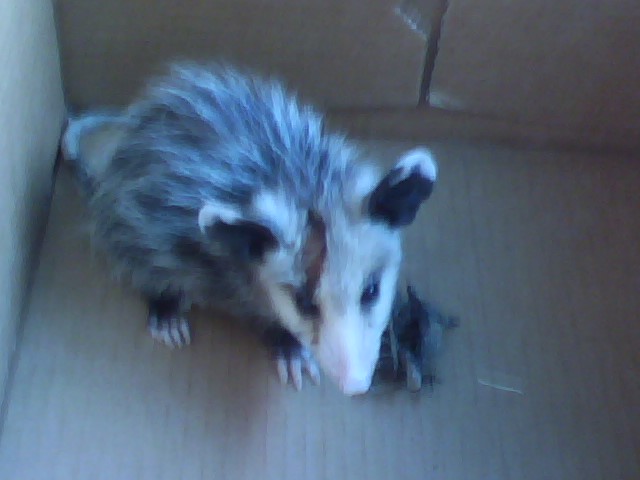
Here is a photo of a little guy we found across the street. It was chewing on the remains of a little bird that had fallen out of its nest. It was right on the curb and I was concerned about it getting run over. My son and I put it in a box and took it to a ditch area behind our house. Usually possums this small are with their mothers. This little guy appeared weak and the wound on its head is very apparent. The heart in me wanted to take him in and get him up to strength. What to do? During this season, a lot of little birds will be falling from the trees. There is really nothing you can do for them. A young bird, yet to reach flight, is extremely vulnerable to pet cats and dogs. Feeding and caging them from your own pet, is impossible. Birds, possums, same problem.
I regret that I didn't leave that little fellow with some dog food or a can of tuna. However, my son and I did remove him from the dangers of man (cars). We took positive action. We did leave him in nature in a more secure location than when we found him. Nature has already been cruel.
We did our part. There is a philosophical lesson here somewhere.
Regards,
Christopher
08 May 2008
From Today's New York Times
To the Editor:
Re “Another Horse-Racing Horror” (editorial, May 6):
Thank you for adding your voice to the many who are demanding that the welfare of racehorses should come before profits. But let us also give thought to the thousands of horses that are bred every year for racing and don’t make the cut or outlive their usefulness to the investors and owners.
Most wind up auctioned off for a few dollars each and sent to the foreign slaughterhouses to be made into pet food or dinner for someone overseas. Even the 1986 Kentucky Derby winner Ferdinand ended up in a Japanese slaughterhouse because he wasn’t proving his monetary value as a stud.
It’s not just the injured horses that suffer. It’s the thousands of faceless colts and fillies we never see that suffer from this so-called sport.
Jane Shakman
Ossining, N.Y., May 6, 2008
From the Mailbag
Keith,
Here is an online ethics and animals class I developed for the Humane Society of the United States. Perhaps its content would be useful for your readers.
Thanks
Nathan Nobis, Ph.D.
Here is an online ethics and animals class I developed for the Humane Society of the United States. Perhaps its content would be useful for your readers.
Thanks
Nathan Nobis, Ph.D.
07 May 2008
Babies and Animals, Part 2
Seven months after R. G. Frey's essay was published, philosophers Dale Jamieson and Tom Regan replied to it. (Dale Jamieson and Tom Regan, "Animal Rights: A Reply to Frey," Analysis 38 [January 1978]: 32-6.) They make the following points:
1. Nobody makes the argument Frey criticizes. It is certainly not an "important argument," as Frey claims.I think point 2 is shaky. Animals are not rational in any meaningful sense, and if they are not rational, then they are not potentially rational. Point 3 is a good reply, in my opinion. The right not to be made to suffer derives from (i) sentience and (ii) the intrinsic badness of pain. As for point 1, I don't see why it matters whether anyone has made the argument. It's an argument in favor of animal rights. Those who deny that animals have rights (e.g., Frey) must find fault with it. As for whether it's an "important" argument, I don't know. Nothing hinges on whether it is.
2. Frey claims that there are only three grounds for premise 2 of the argument: potentiality, similarity, and immortality. None of these grounds, he says, applies to animals. Jamieson and Regan reply that some animals are potentially rational. If so, then it is not the case, as Frey claims, that every ground for affirming premise 2 renders premise 1 false. At least one ground for affirming premise 2 renders premise 1 true.
3. The three grounds Frey supplies for premise 2 are not exhaustive. There is at least one other ground—namely, sentience—for the proposition that babies have rights. Unfortunately for Frey, this ground, unlike the three he supplies, does not preclude animals from having rights. Since both babies and animals are sentient, both have rights.
06 May 2008
Babies and Animals
Here is a common argument in favor of animal rights:
What is Frey's argument? Frey claims that (i) there are only three grounds for ascribing rights to babies and (ii) none of them applies to animals. Thus, what makes premise 2 true makes premise 1 false. What are the three grounds?
1. If babies have rights, then animals have rights.In 1977, philosopher R. G. Frey argued that at least one of the premises of this argument must be false, and hence that the argument is unsound. (R. G. Frey, "Animal Rights," Analysis 37 [June 1977]: 186-9.) This doesn't show that animals don't have rights, for an unsound argument can have a true conclusion; but it does show—if Frey is right—that there must be some other basis for animal rights than the one provided by this argument.
2. Babies have rights.
Therefore,
3. Animals have rights.
What is Frey's argument? Frey claims that (i) there are only three grounds for ascribing rights to babies and (ii) none of them applies to animals. Thus, what makes premise 2 true makes premise 1 false. What are the three grounds?
1. Potentiality. Babies may not be rational, but they're potentially rational. If we ascribe rights to babies on the basis of their potential rationality, we thereby deny rights to animals, for animals are not even potentially rational.One way to challenge Frey is to show that (i) there is a ground other than these three for ascribing rights to babies and (ii) it applies to animals. Can you think of such a ground?
2. Similarity. Babies may not be rational, but they're similar in many other respects to "other members of our species." If we ascribe rights to babies on the basis of their similarity to other human beings, we thereby deny rights to animals, for animals are not similar in many other respects to human beings.
3. Immortality. Babies may not be rational, but they have immortal souls. If we ascribe rights to babies on the basis of their immortality, we thereby deny rights to animals, for animals are not immortal.
04 May 2008
Plant Rights
Here is an essay by Wesley J. Smith. There is no inconsistency in rejecting plant rights while accepting animal rights. If Smith thinks that plant rights and animal rights stand or fall together, then he is confused, for there is a morally relevant difference between plants and animals, namely, that only the latter are sentient.
Addendum: Smith appears not to understand the animal-rights movement. He writes:
Addendum 2: Smith wants the circle of moral concern to be the same as the circle of biological humanity. In his view, neither animals nor plants have rights. He seems to think that if we expand the circle to include animals, we will have to expand it, on pain of inconsistency, to include plants. This is false, for there is, as I say, a morally relevant difference between animals and plants that justifies drawing a line between them. The circle of moral concern should include all sentient beings, not all living organisms.
Addendum 3: When I was a law student at Wayne State University in the early 1980s, I took a graduate philosophy course in ethics with Bruce Russell. He allowed me to write a term paper entitled "Do Plants Have Rights?" Little did I know that I'd be coming back to that topic a quarter of a century later!
Addendum 4: Smith should grapple with the biocentric arguments of Paul W. Taylor in Respect for Nature: A Theory of Environmental Ethics (Princeton: Princeton University Press, 1986). It is one of the best books I've read. It sounds to me as though Europeans are taking Taylor's theory seriously.
Addendum: Smith appears not to understand the animal-rights movement. He writes:
The animal rights movement grew out of the same poisonous soil. Animal rights ideology holds that moral worth comes with sentience or the ability to suffer. Thus, since both animals and humans feel pain, animal rights advocates believe that what is done to an animal should be judged morally as if it were done to a human being. Some ideologues even compare the Nazi death camps to normal practices of animal husbandry. For example, Charles Patterson wrote in Eternal Treblinka—a book specifically endorsed by People for the Ethical Treatment of Animals—that "the road to Auschwitz begins at the slaughterhouse."Animal-rights advocates do not believe "that what is done to an animal should be judged morally as if it were done to a human being." What they believe is that animals matter, morally. Animals have weight on the moral scale. Morally speaking, animals are something, not nothing. Inflicting pain on animals must be justified. This is not to say that it can't be justified, only that it must be.
Addendum 2: Smith wants the circle of moral concern to be the same as the circle of biological humanity. In his view, neither animals nor plants have rights. He seems to think that if we expand the circle to include animals, we will have to expand it, on pain of inconsistency, to include plants. This is false, for there is, as I say, a morally relevant difference between animals and plants that justifies drawing a line between them. The circle of moral concern should include all sentient beings, not all living organisms.
Addendum 3: When I was a law student at Wayne State University in the early 1980s, I took a graduate philosophy course in ethics with Bruce Russell. He allowed me to write a term paper entitled "Do Plants Have Rights?" Little did I know that I'd be coming back to that topic a quarter of a century later!
Addendum 4: Smith should grapple with the biocentric arguments of Paul W. Taylor in Respect for Nature: A Theory of Environmental Ethics (Princeton: Princeton University Press, 1986). It is one of the best books I've read. It sounds to me as though Europeans are taking Taylor's theory seriously.
H. J. McCloskey on Animal Rights
The issue as to who or what may be a possessor of rights is not simply a matter of academic, conceptual interest. Obviously, important conclusions follow from any answer. If, for instance, it is determined that gravely mentally defective human beings and monsters born of human parents are not the kinds of beings who may possess rights, this bears on how we may treat them. It does not settle such questions as to whether it is right to kill them if they are a burden or if they are enduring pointless suffering, but it does bear in an important way on such questions. Even if such beings cannot be possessors of rights it might still be wrong to kill them, but the case against killing those who endure pain is obviously easier to set out if they can be shown to be capable of possessing rights and in fact possess rights. Similarly, important conclusions follow from the question as to whether animals have rights. If they do, as Salt argued, it would seem an illegitimate invasion of animal rights to kill and eat them, if, as seems to be the case, we can sustain ourselves without killing animals. If animals have rights, the case for vegetarianism is prima facie very strong, and is comparable with the case against cannibalism.
(H. J. McCloskey, "Rights," The Philosophical Quarterly 15 [April 1965]: 115-27, at 122 [footnote omitted])
(H. J. McCloskey, "Rights," The Philosophical Quarterly 15 [April 1965]: 115-27, at 122 [footnote omitted])
01 May 2008
Statistics
I almost feel guilty about not posting more often (and more substantively) on this blog, given its expanding readership. This past month, there were 5,208 visitors to the blog, which is an average of 173.6 per day. The previous records (set in March 2008) were 4,200 and 135.4. I have a number of posts about animals waiting in the wings, but I have been saving them for summer, when I have more time. One of them is a long critique of philosopher David Oderberg's argument against animal rights. Mylan and I appreciate your interest in our blog. Perhaps Jonathan will post some items this summer as well. He has been busy with his studies at UT-Austin.
30 April 2008
27 April 2008
From Today's New York Times
To the Editor:
Re “PETA’s Latest Tactic: $1 Million for Fake Meat” (news article, April 21):
The commercial development of meat from animal tissue won’t result in “fake meat” any more than cloning sheep results in fake sheep.
Quite the contrary, lab-based techniques have the potential to yield far purer meat, uncontaminated with growth hormones, pesticides, E. coli bacteria or food additives. A more accurate name for the end result would therefore be “clean meat.”
In addition, clean meat has a key advantage not mentioned in your article: it’s much more climate-friendly than traditional meat.
More greenhouse gas emissions are generated by current methods of meat, dairy and livestock production than by driving cars, so we need to reduce meat consumption and develop alternative food production technologies just as urgently as we need to reduce driving and develop alternative fuel technologies.
Scott Plous
Middletown, Conn., April 21, 2008
To the Editor:
Re “Million-Dollar Meat” (editorial, April 23):
In vitro meat might not appeal to everyone, but I am guessing that the day PETA awards its prize money will be a happy day for the billions of land animals bound for slaughter.
We can treasure the cultural and historical bond between animals and domesticated animals only by ignoring the emotional bond. Children naturally love animals, but the many “uses we have found for them” lead us to teach our children to save their compassion for companion animals exclusively.
We encourage kids to gently pet baby lambs, cows, chickens and pigs, but we deny them this loving connection when we serve animals for dinner by surreptitiously calling them chops, hamburger, nuggets and bacon.
There is no happy ending for even the most humanely raised animal. And there is no good reason to breed, confine and kill animals for food unless we believe that economic benefit justifies killing. More and more people do not. We call ourselves vegetarians.
Patti Breitman
Fairfax, Calif., April 23, 2008
To the Editor:
You suggest that the raising of animals for food should be done “in ways that are both ethical and environmentally sound.” This is asking for the impossible.
More than nine billion chickens are slaughtered each year in the United States. When you treat animals as objects on an assembly line, it is not possible to provide for their basic needs.
You argue that we must treasure a “cultural and historical bond” between us and those we eat. But that bond is based on exploitation and abuse.
If domesticated animals “exist only because of the uses we have found for them,” let me ask you: Would you have recommended 150 years ago that we preserve and treasure the bond between whites and their black slaves—and develop a more humane slave trade?
Vadim Liberman
New York, April 23, 2008
26 April 2008
23 April 2008
Using Animals as Mere Means to One's Ends
The editorial board of the New York Times weighs in on in vitro meat. I can't be sure, since the editorial opinion is so jumbled, but the board seems to be arguing that people should continue to eat meat, provided the animals whose flesh they consume are not made to suffer. Would the board say the same thing about humans? Is it permissible to eat human flesh, provided the humans whose flesh one consumes are not made to suffer?
Leonard Nelson (1882-1927) on Duties and Rights
All so-called duties to oneself, in so far as they deserve the name of duties, are indirect, and as such presuppose duties to other persons. With this finding we are safeguarded against the error of fallaciously extending the scope of our duties. But an opposite error is possible, that of fallaciously restricting the scope of our duties. If we designate a being in relation to whom we have duties as an "object of duties," we may say that only other persons can be objects of duties. In addition, we assert that all other persons, in so far as we affect them by our actions, are objects of duties for us. For every person, being a subject of interests, has rights, i.e., has a claim to respect of his interests under the law of equality of persons.
Failure to understand this leads to the above-mentioned false restriction of the scope of duties—a dangerous error far more prevalent in ethics than the opposite error of fallaciously extending the scope of duties. If we assume the existence of more duties than there actually are, we at least do not directly violate any duty; but if we assume that there are fewer duties than we actually have, we are directly led to such a violation. The proposition asserting that all persons can be objects of duties is therefore of greater practical significance than the proposition asserting the nonexistence of duties to oneself.
To recognize the full import of the former proposition, we must sharply distinguish between the concepts "subject of duties" and "subject of rights": for we cannot rule out a priori the possibility that some subjects of rights are not subjects of duties. Under the moral law, all beings who have interests are subjects of rights, while all those who in addition to having interests, are capable of grasping the demands of duty, are subjects of duties. Only rational beings are capable of such an understanding. Accordingly, we may classify all duties remaining after exclusion of duties to oneself into duties in relation to rational and to nonrational beings. If we designate as an animal a being that is a subject of rights, but is by its nature incapable of attaining rational self-determination, and as a man a being that is a subject of rights and at the same time potentially endowed with reason, we may state briefly that duty is always either to an animal or to a man. It is my contention that we have duties to animals, and that these duties are direct, i.e., that they are not derived from duties to men, or rational beings.
(Leonard Nelson, System of Ethics, trans. Norbert Guterman [New Haven: Yale University Press, 1956], 136-7 [italics in original] [first published in German in 1932])
Note from KBJ: Nelson's "subject of duties" is what philosophers now call a moral agent. The defining characteristic of moral agency is autonomy ("rational self-determination"). His "subject of rights" is what philosophers now call a moral patient. The defining characteristic of moral patiency is the possession of interests. To see the relation between the concepts, draw two partially overlapping circles. Let the left circle represent the class of moral agents and the right circle the class of moral patients. This creates four mutually exclusive and logically exhaustive categories: (1) things that are moral agents but not moral patients; (2) things that are both moral agents and moral patients; (3) things that are moral patients but not moral agents; and (4) things that are neither moral agents nor moral patients. Category 1 is empty. Normally functioning adult human beings are in category 2. Nonhuman animals (even apes) are in category 3. Plants, rocks, chairs, and other things are in category 4. Nelson says that we have duties to both animals and humans. Our duties to animals are grounded in their possession of interests. Our duties to humans are grounded either in their possession of interests or in their possession of autonomy. Already, by 1927, Nelson had laid the conceptual groundwork for two types of rights: interest-rights (which humans share with animals) and autonomy-rights (which only humans have).
From Today's New York Times
To the Editor:
In his past comments about protecting animals and nature, Pope Benedict XVI is building upon the Roman Catholic Church’s tradition of promoting faithful stewardship of all creatures (“A Cat Lover in the Vatican Strikes a Chord With Cat Lovers Around the World,” news article, April 20).
The United States Conference of Catholic Bishops and the Catholic catechism affirm that compassion for animals is a matter of human dignity. The Catholic Church is not alone among major religions on this issue.
The Episcopal Church embraces a resolution that specifically addresses puppy mills and factory farms. The United Methodist Church supports the humane treatment of farm animals and calls for the protection of endangered species. The Evangelical Lutheran Church in America asserts that “God’s command to have dominion and subdue the earth is not a license to dominate and exploit.”
The Assemblies of God position on stewardship reflects that of the Evangelical Lutheran Church of America. The Central Conference of American Rabbis “advocates the strengthening of humane legislation,” and the list goes on.
Christine Gutleben
Washington, April 21, 2008
The writer is the director of animals and religion at the Humane Society of the United States.
21 April 2008
In Vitro Meat
18 April 2008
Are Animals Sentient?
Here is a passage from John Rodman's classic essay "The Dolphin Papers," The North American Review 259 (spring 1974): 13-26, at 24:
Addendum: I read Rodman's essay for the first time on 18 January 1981, when I was 23 years old and in my second year of law school. It has influenced me more than almost anything else I have read. If you'd like a PDF version of it, let me know.
St. Augustine [354-430] had long ago decided that beasts were incapable of suffering pain, because otherwise God would be unjust. (Assume that beasts share neither in original sin nor in eternal life; then for them to suffer pain seems to contradict the principle that "God being just, no being suffers undeservedly"; therefore, animals must not be thought to suffer pain.)As I interpret the argument, it goes like this:
1. If (a) animals are sentient (i.e., capable of suffering), (b) animals are innocent (i.e., not afflicted by original sin), and (c) animals lack immortal souls, then there is undeserved suffering.The argument is valid, so everybody must either reject 1, reject 2, reject 4, reject 7, reject 8, or accept 9. Augustine accepts 9. I reject 4, which falsely presupposes that God exists. How do you respond?
2. If there is undeserved suffering, then God is unjust.
Therefore,
3. If (a) animals are sentient, (b) animals are innocent, and (c) animals lack immortal souls, then God is unjust (from 1 and 2, hypothetical syllogism).
4. God is not unjust.
Therefore,
5. It is not the case that [(a) animals are sentient, (b) animals are innocent, and (c) animals lack immortal souls] (from 3 and 4, modus tollens).
Therefore,
6. Either (a) animals are not sentient, (b) animals are not innocent, or (c) animals have immortal souls (from 5, DeMorgan's theorem).
7. Animals are innocent.
8. Animals lack immortal souls.
Therefore,
9. Animals are not sentient (from 6, 7, and 8, disjunctive syllogism).
Addendum: I read Rodman's essay for the first time on 18 January 1981, when I was 23 years old and in my second year of law school. It has influenced me more than almost anything else I have read. If you'd like a PDF version of it, let me know.
17 April 2008
Should We Legalize Dog Meat?
Should we legalize dog meat for human consumption? For a discussion of the issue, see William Saletan’s recent post at the Human Nature Blog.
Saletan discusses some reader reactions to his first post on legalizing dog meat here.
What's next? Soylent green?
Weigh in. What do you think? Should we be eating dog meat?
Saletan discusses some reader reactions to his first post on legalizing dog meat here.
What's next? Soylent green?
Weigh in. What do you think? Should we be eating dog meat?
16 April 2008
Henry S. Salt (1851-1939) on the Appeal of Vegetarianism
It cannot be too strongly stated that the appeal of Vegetarianism, as of all humane systems, is not to heart alone, nor to brain alone, but to brain and heart combined, and if its claims fail to win this double judgment they are necessarily void and invalid. The test of logic no less than the test of feeling is deliberately challenged by us; for it is only by those who can think as well as feel, and feel as well as think, that the diet-question, or indeed any great social question, can ever be brought to its solution.
(Henry S. Salt, The Logic of Vegetarianism: Essays and Dialogues [London: The Ideal Publishing Union, 1899], 3)
(Henry S. Salt, The Logic of Vegetarianism: Essays and Dialogues [London: The Ideal Publishing Union, 1899], 3)
14 April 2008
11 April 2008
From Today's New York Times
To the Editor:
In answering the question “What should be done?” about the world food crisis, Paul Krugman doesn’t mention an obvious and important solution: Eat less meat. The 700 calories’ worth of animal feed he says it takes to produce 100 calories of beef contributes nothing to the well-being of consumers.
With a little experimentation, anyone can find satisfying substitutes for meat that will improve personal health and the health of the planet at the same time. I urge your readers to give it a try.
Nancy Dorfman
Belmont, Mass., April 8, 2008
Growing Meat vs. Going Vegetarian
In today's Dot Earth post "Can People Have Meat and a Planet, Too?," Andrew Revkin explores the brave new world of growing meat cultures in vitro as a more humane and possibly more environmentally friendly way of producing meat.
In his post, Revkin cites Jesse Ausubel, Director of the Program for the Human Environment at Rockefeller University. Ausubel expresses pessimism about the ability of humans to change their diets from environmentally destructive meat-based diets to environmentally sustainable plant-based diets on the grounds that the desire for meat is somehow hard-wired into "our little snake brains." While by no means optimistic, I'm certainly less pessimistic than Ausubel. First of all, people can change. Every day, some people switch from meat-based diets to vegetarian diets. Every day, some people make the switch to entirely plant-based vegan diets. Some people make the switch for ethical reasons, others for health reasons, others out of concern for the environment, and some for a combination of all these reasons. (As Keith and I have repeatedly pointed out, the case for plant-based diets is overdetermined.)
Admittedly, one is forced to ask why more people don't make such life- and planet-affirming choices. It could be "our little snake brains," as Ausubel suggests. But then again, it could be due to the fact that we are constantly bombarded with billion-dollar advertising campaigns from the meat industries, the dairy industry, and the egg industry, as well as from myriad restaurant chains that promote and sell these very animal products. These industries and corporations don't spend their huge advertising budgets for no reason. They do so because they know that doing so stimulates and reinforces demand for their health- and planet-destroying products. I suspect that such advertising has far more to do with our dietary choices than a biologically hard-wired craving for meat and diary products, especially since in other parts of the world, consumption of meat is rare to nonexistent. (Consider, e.g., the traditional low animal-protein diets in rural China and the vegetarian diets of 15 million Jains.)
Couple the fact that the average TV viewer is exposed to some sort of pro-animal-product ad every ten minutes or so, with the lack of accurate information about the genuine health and environmental benefits of plant-based diets, and it's no wonder that more people haven't switched to plant-based diets.
Why do so many people lack accurate information about the health and environmantal benefits of plant-based diets? In part, because of media obfuscation. Yes, the media who profit from these animal-industry advertising dollars are complicit in not reporting information that would potentially hurt the sales of their major advertisers. How many people know, e.g., that University of Chicago researchers have reported that by switching to a vegan diet, a person can reduce her/his carbon footprint by 1.5 metric tons per year? That's more than switching from an SUV to a Prius.
Fortunately, a growing number of blogs, like Dot Earth, Animal Ethics, and many of the other blogs linked to in our blog roll, are getting out accurate information to a wide audience, information that can help readers make informed responsible choices regarding both their and the planet's health.
I conclude with a challenge. I challenge you to try the following experiment: Turn off your TV for an entire month. Don't watch it at all. Not once. See whether your desire for meat doesn't wane in the absence of larger-than-life images of animal products flashing across the screen. At the same time, try a vegetarian diet for a month. Get a good vegetarian cookbook—preferably one with full-page enticing photos of succulent vegetarian dishes. Find a few recipes that intrigue you. See whether you enjoy the food that you are consciously choosing to prepare and eat as much as the food you've been manipulated into consuming by industry advertisements. To your health and the health of the planet!
09 April 2008
From the Mailbag
Dear Professor Burgess-Jackson,
The Michigan Law Review’s companion journal First Impressions this week published an online symposium on Agricultural Animals and Animal Law.
If you would like to post about the symposium on the Animal Ethics blog, please feel free either to link to the recent post at Concurring Opinions or to post something new, perhaps based on the content of the announcement, below. The symposium includes contributions that discuss the moral status of nonhuman animals.
Please do not hesitate to contact us if you have any questions or require additional information about the symposium.
Best regards,
Bradley Moore
Executive Editor of First Impressions
Michigan Law Review
08 April 2008
From Today's New York Times
To the Editor:
While businesses that rent dogs may be well intentioned, they’re unlikely to benefit the overall welfare of pets, and may actually do harm to the individual dogs they “rent” (“For a Temporary Best-Friend Fix, Rent a Dog (Kibble Included) for a Day,” news article, March 30).
A dog is a lifetime friend and companion—not a two-hour rental. Dogs form attachments to their families and thrive on consistency. Frequent and abrupt changes in location, routine, discipline and attention are confusing and stressful. Moving them from person to person, home to home, can induce problems such as anxiety and depression.
Dog lovers who are unable to make a lifelong commitment to a pet can volunteer with animal shelters and rescue groups, and provide foster care in their home for an animal awaiting permanent adoption.
There are better and more fulfilling options for these animals and people who need a doggie fix.
Michael Markarian
Washington, March 31, 2008
The writer is the executive vice president of the Humane Society of the United States.
04 April 2008
The Family Farm
Here is a New York Times story about traditional farming, which is a darn sight better for animals than factory farming.
01 April 2008
Statistics
There were 4,200 visits to this site during March. That's an average of 135.4 visits per day, which is a record. The previous best month was November 2007 (3,836 and 127.8). I assume that many of the visitors have come here from Dot Earth. Mylan and I are grateful to Andrew Revkin for the link.
31 March 2008
30 March 2008
From Today's New York Times
To the Editor:
Re “With More News of Abuse, a Harder Search for Homes for Pit Bulls” (Westchester and the Region, March 16):
As a member of the League of Humane Voters of Westchester, I thank you for covering the efforts by the police and the Society for the Prevention of Cruelty to Animals to stop the dog fighting and animal cruelty in Westchester County.
The Westchester chapter of the league is calling on the county executive, Andrew J. Spano, and the mayor of Yonkers, Philip A. Amicone, to establish a task force dedicated to ending the dog-fighting in Westchester, and specifically in the City of Yonkers, site of most of the fights.
Yonkers prides itself on its gentrification and revitalization efforts. It is a blight on Westchester to have a city consistently in the news for such an odious activity.
The Michael Vick case shed light on the disgrace of those who cause dogs to fight each other, an event often accompanied by drug sales and prostitution. The animals are forced to fight through beatings, starvation, being thrown at each other, being made to attack smaller animals thrown at them, and worse.
We are tired of our dogs being bloodied, broken, scarred, crippled, killed and thrown into garbage cans. We are tired of our Westchester community being shown on TV in such an ugly light.
Let’s send a message to dog fighters: You are not welcome here.
Julie Serenson
Yonkers, March 23, 2008
29 March 2008
From Today's New York Times
To the Editor:
Re “Thinning Yellowstone’s Bison Herd” (news article, March 23):
Yellowstone National Park bison, executed when they migrate outside the boundaries of the park, have plenty of company. Around the world, animal migrations are disappearing because of conflicts with development, agriculture and other human activities.
In the greater Yellowstone ecosystem alone, over half of the elk migratory routes and three-quarters of the antelope routes have been destroyed by sprawl, oil and gas development, and farming.
Earlier this month, NASA released new satellite photographs showing continued illegal cutting of the Mexican fir forests where virtually all of eastern North America’s monarch butterflies spend the winter.
And bird watchers across the United States and Canada face the prospect of a quieter, less colorful spring as a combination of climate change, tropical deforestation, mountaintop mining in the Appalachians and other activities destroys key wintering, breeding and stopover habitats.
The loss of migration is of more than aesthetic importance. Migratory birds protect forests and crops from insect pests; butterflies, bats and other migratory species are important pollinators.
Indeed, migratory animals are useful indicators of the health of the global environment; their safe passage is in our best interest.
David S. Wilcove
Princeton, N.J., March 24, 2008
The writer is the author of a book about the decline of the world’s great animal migrations.
27 March 2008
From the Mailbag
I wanted to let you know about a website called AnimalAttraction.com where animal lovers come together to meet and oftentimes find love. We have many great stories from all over the country where folks had given up on having any romance in their life until they met at AnimalAttraction—everyone says it is much easier to get to know someone with your dog on the date too!
I was just contacted by a new couple who emailed me pictures of their wedding at the American Kennel Club where they tied the knot in the Best in Show ring. Where else? The bride was walked down the aisle by her standard poodle, John.
Also Animal Attraction is donating at least $100,000 to various animal charities next month (April is animal cruelty prevention month) to give back to the community we all adore—our pets!
Thanks for your time and please feel free to contact me with any questions!
Joanne Poesch
Recipe Idea!
For those of you who think that vegetarian cuisine must be bland and boring, think again. You'll find the recipe for Spaghetti con Rucola e Ricotta here. There's even an alleged aphrodisiac effect associated with arugula. That should inspire all but the most hardened meat-eaters to give it a try!
Bon Appetit!
Bon Appetit!
Note: This dish will be much more healthful and just as tasty if you omit the ricotta cheese or replace it with crumbled firm tofu.
26 March 2008
From the Mailbag
Hi there :)
I was hoping that we could do a link swap! I run a store called CutiePaws. I make animal plushies and donate 60% from each sale to AnimalsAsia's China Bear Rescue. :) My goal is to raise at least $1,000 this year, and you would be really helping me out by swapping links with me. :)
Let me know if you're interested!
Thank you very much,
Jenn Hartnoll
CutiePaws
60% of each sale is donated to AnimalsAsia's China Bear Rescue!
Global Warming
According to Yahoo! News, recent satellite pictures reveal that a chunk of Antarctic ice 7 times the size of Manhattan has collapsed and broken apart. The 160-square-mile chunk broke apart in Western Antarctica in what is called the Wilkins Ice Shelf. See here for video footage of the event.
Note from KBJ: I have a question for you, Mylan. Do you believe that a warmer globe would be bad for animals, all things considered? If so, what is the basis of your belief? Before answering, read this.
Note from KBJ: I have a question for you, Mylan. Do you believe that a warmer globe would be bad for animals, all things considered? If so, what is the basis of your belief? Before answering, read this.
24 March 2008
22 March 2008
21 March 2008
20 March 2008
A Vindication of the Rights of Brutes
In 1792, Englishman Thomas Taylor (1758-1835), a prominent translator of Plato and other Greek philosophers, published a satirical pamphlet entitled A Vindication of the Rights of Brutes. His aim in this anonymous work was to mock Mary Wollstonecraft's books A Vindication of the Rights of Men (1790) and Vindication of the Rights of Woman (1792), as well as Thomas Paine's Rights of Man (1791). Taylor's argument may be reconstructed as follows:
Addendum: Here's another way to look at it. As between B and C, Taylor thinks B more likely to be true. Indeed, he thinks B is obviously true and that its denial is laughable. I think C more likely to be true. Indeed, I think C is obviously true and that its denial is laughable. One person's modus ponens is another's modus tollens.
Addendum 2: To give you a taste of Taylor's wicked prose, I quote the final paragraph:
1. If women have rights, then animals have rights.In effect, Taylor is claiming (correctly) that the following three propositions are inconsistent:
2. Animals do not have rights.
Therefore,
3. Women do not have rights.
A. If women have rights, then animals have rights.To say that these propositions are inconsistent is to say that not all of them can be true. At least one, therefore, is false. Taylor thinks C is the false proposition. I think B is the false proposition. What do you think?
B. Animals do not have rights.
C. Women have rights.
Addendum: Here's another way to look at it. As between B and C, Taylor thinks B more likely to be true. Indeed, he thinks B is obviously true and that its denial is laughable. I think C more likely to be true. Indeed, I think C is obviously true and that its denial is laughable. One person's modus ponens is another's modus tollens.
Addendum 2: To give you a taste of Taylor's wicked prose, I quote the final paragraph:
And thus much may suffice, for an historical proof, that brutes are equal to men. It only now remains (and this must be the province of some abler hand) to demonstrate the same great truth in a similar manner, of vegetables, minerals, and even the most apparently contemptible clod of earth; that thus this sublime theory being copiously and accurately discussed, and its truth established by an indisputable series of facts, government may be entirely subverted, subordination abolished, and all things every where, and in every respect, be common to all.It's a good thing Taylor didn't live to see Paul W. Taylor's book Respect for Nature: A Theory of Environmental Ethics (Princeton: Princeton University Press, 1986), in which his namesake defends biocentrism (a life-centered, as opposed to human-centered, ethic). Four beliefs form "the core of the biocentric outlook" (99):
(a) The belief that humans are members of the Earth's Community of Life in the same sense and on the same terms in which other living things are members of that Community.Ibid., 99-100. Sadly, most of what is being published in environmental ethics (in periodicals such as Environmental Ethics) is rubbish. Some of it is obscure to the point of incomprehensibility. Much of it is progressive politics masquerading as philosophy. I highly recommend Paul Taylor's book.
(b) The belief that the human species, along with all other species, are integral elements in a system of interdependence such that the survival of each living thing, as well as its chances of faring well or poorly, is determined not only by the physical conditions of its environment but also by its relations to other living things.
(c) The belief that all organisms are teleological centers of life in the sense that each is a unique individual pursuing its own good in its own way.
(d) The belief that humans are not inherently superior to other living things.
Between the Species
Here is an online journal that should be of interest to readers of this blog. I will add a link to the blogroll.
19 March 2008
From the Mailbag
Hi Keith,
Below is a calendar listing for Farm Sanctuary's annual Country Hoe Down at our Orland, California Shelter. We would be very appreciative if you would please list and help us raise awareness about this inspirational and educational event for farm animal advocates.
Please let me know if you would like more information.
Warm Regards,
Natalie Bowman
Communications Coordinator
Farm Sanctuary
P.O. Box 150, Watkins Glen, NY 14891
18 March 2008
From the Mailbag
Hi! I am a long time vegetarian, now vegan for 10 years, and animal lover.
I wanted to pass on these amazing groups I'm a part of for possible features/links on your blog:
Thank you,
Michele Glick
I wanted to pass on these amazing groups I'm a part of for possible features/links on your blog:
I run Etsy for Animals: Artists Helping Animals, a group of artists andPlease let me know if you feature any of the above,
artisans helping animals, many are veg/vegan and donate to animal charities thru
sales: http://etsyforanimals.com/
Our shop w/100% to animal charity: http://etsyforanimals.etsy.com/
Vegan Etsy: Creating Without Cruelty: http://veganetsy.blogspot.com/
Cruelty Free Etsy: http://crueltyfreeetsy.blogspot.com/
Etsy Veg: http://etsyveg.blogspot.com/
My own vegan friendly shop giving 10% to animal charities: http://mvegan5.etsy.com/
Thank you,
Michele Glick
17 March 2008
From Today's New York Times
To the Editor:
Thank you for publicizing the plight of satos—street dogs—in Puerto Rico in “Scrutiny for Puerto Rico Over Animal Treatment” (news article, March 9).
Sadly, the situation in Puerto Rico is replicated in countries around the world where hundreds of millions of dogs live as strays, abandoned by the humans they have come to depend on for food, shelter and companionship.
Change will take place only when governments work with local and international animal welfare groups and concerned individuals to address the root of the problem through education and humane methods of population control, such as spaying and neutering.
As one animal advocate put it, “we need to work together and keep the finger in the side of government.”
Thank you for doing just that, by telling the American public what’s happening in Puerto Rico through your compelling article and photographs.
Allan Kornberg
Boston, March 11, 2008
The writer is executive director of the World Society for the Protection of Animals.
16 March 2008
From Today's New York Times
To the Editor:
Re “Oceans at Risk” (editorial, March 9): We are in danger of ruining the world’s oceans and endangering marine ecosystems. You are right that what is needed is “a sustained effort by world governments and other institutions to do something about it” and that “the problems are global and so, in the end, are the solutions.”
One key solution, as you note, rests with the United States Senate: the Law of the Sea Convention. But without the political muscle of President Bush to illustrate the importance of this treaty to holdouts in his own party, the treaty will languish and our oceans will continue to be degraded.
As a nation, we value responsibility and cooperation. Ratification of the Law of the Sea would send an important message to the more than 150 countries that have already joined the treaty, including all of our allies, that we are committed partners in protecting the planet and its people.
Howard Salter
Director of External Relations, Citizens for Global Solutions
Washington, March 10, 2008
15 March 2008
From Today's New York Times
To the Editor:
Re “A Case of Abuse, Heightened,” by Joe Nocera (Talking Business column, March 8):
Mr. Nocera tells us that most slaughterhouses don’t mistreat animals or funnel sick downer cows into the food chain. Oh, really?
If Mr. Nocera actually had such clairvoyant powers over the meat-packing industry, why didn’t he put them to use last autumn and blow the whistle on the Westland/Hallmark slaughter plant? He would have saved us the necessity of sending an undercover investigator to film the shocking mistreatment of animals. He might have prevented the recall of 143 million pounds of beef.
Mr. Nocera is anything but a soothsayer. He has simply rehashed the party line from the slaughterhouse industry. Most Americans, by contrast, join with us in demanding better regulations to safeguard farm animals and more credible inspections of our food.
Wayne Pacelle
President and Chief Executive
The Humane Society of the United States
Washington, March 8, 2008
14 March 2008
13 March 2008
Housekeeping
As unbelievable as it may sound, I still get comments without full names. Can you people read? Here is what it says on the editorial page of my local newspaper, the Fort Worth Star-Telegram:
LETTERS POLICYThink of this blog as a newspaper. Full names only. When a comment comes in without a full name, I reject it without reading it.
Verification: Letters must have a printed full name, address and daytime phone number.
Frequency: Writers are limited to one letter a month.
Content: Be concise, to the point and original. Length is subject to editorial judgment, and letters will be edited to comply with Star-Telegram style and standards.
From the Mailbag
Dear Keith, Mylan, and Jonathan,
My name is Miry and I’m from Potomac, Maryland. First of all, I want to tell you how much I enjoy Animal Ethics. It is beautifully written with wonderful perspective. I read it all the time. I especially liked your posting from Gardner Williams’ “The Moral Insignificance of the Total of All Value.” I found this very inspiring, and would have never have seen it if not for your blog, so thank you for that.
I want to tell you about a website I just launched, called AnimalWork.org. It’s a job-matching site for all jobs related to animals, like training, grooming, veterinary medicine, caretaking, zoo positions, and much, much more. What makes the site special is that a portion of every sale is donated to animal rights and rescue organizations. If the majority of your blog readers are animal lovers like me, then I know they’d love my site.
I would love if you could mention AnimalWork.org on Animal Ethics to let your readers know about it. The link would be really helpful for spreading the word, and supporting the fantastic organizations that work endlessly to make this world a more animal-friendly place. I would also be happy to post a link to Animal Ethics on the AnimalWork.org blog.
Feel free to get in touch with me if you have any questions about AnimalWork.org, just want to say hello, or to recommend an animal-friendly non-profit that you think we should support. I am attaching our “Blog Pawsitive” newsletter that will give you more information about why AnimalWork.org is so awesome. Thank you!
Be Pawsitive!
Miry Whitehill
Director, AnimalWork.org
12 March 2008
From Today's New York Times
To the Editor:
Re “To Revive Hunting, States Turn to the Classroom” (front page, March 8):
Shame on West Virginia if it approves a bill that allows hunting education classes in public schools to become law.
We should not use public schools to try to reverse the inexorable decline in the “sport” of hunting.
The killing and maiming of animals for sport is a cruel and violent activity that is the antithesis of what schools should be teaching. Furthermore, in the context of a dramatic increase in school violence in recent years, to teach hunting is ludicrous.
We should be teaching our children how to be better citizens of the community, and that certainly does not include taking up arms against other living beings.
Brad Goldberg
President, Animal Welfare Advocacy
Mamaroneck, N.Y., March 8, 2008
11 March 2008
From the Mailbag
I just wanted to pass on a link to a recent national geographic article on Animal Minds. Some of the material may be of interest.
Thanks,
Jayme
Thanks,
Jayme
Water Worries—How We're Drugging Other Species
People used to worry that water fluoridation programs were part of a Communist plot. Today, people have to worry about much more than fluoride in their water. Traces of analgesics, antidepressants, antibiotics, antihistamines, anti-hypertension drugs, anti-seizure medications, and birth control hormones are turning up in the Nation's municipally-delivered drinking water and also in our rivers, lakes, and streams. While many city water departments are aware of the problem, most of them aren't sharing that information with their customers. See this AP story for details.
Pharmaceutically-laced water isn't just a problem for humans. It's a problem for animals, particularly aquatic animals, as well. Here is an AP story highlighting the impact these pharmaceutical substances are having on aquatic and avian species. For example, exposure to these substances is negatively impacting the reproductive abilities of some fish species, threatening their extinction. According to the column, more than 100 different pharmaceutical compounds have turned up in surface water around the world. Closer to home, the AP story reports that:
Play it safe. Switch to a plant-based diet. You'll spare the fish, and you'll reduce your exposure to these unwanted pharmaceutical compounds.
Back to water. With drugs turning up in tap water, you might think that purchasing bottled water is a safer bet. But think again. Much of the bottled water available for purchase comes from municipal sources at a cost 100 times greater than tap water. Plus, all those plastic bottles are an environmental nightmare. More information on bottled water is available here.
It would be better for all if we could simply trust our local water departments to provide safe affordable drinking water with full disclosure of all contaminants contained therein. Here's an organization working to ensure the safety and affordability of our water supply.
Till then, you might want to switch to biodynamic organic wine. Cheers!
Pharmaceutically-laced water isn't just a problem for humans. It's a problem for animals, particularly aquatic animals, as well. Here is an AP story highlighting the impact these pharmaceutical substances are having on aquatic and avian species. For example, exposure to these substances is negatively impacting the reproductive abilities of some fish species, threatening their extinction. According to the column, more than 100 different pharmaceutical compounds have turned up in surface water around the world. Closer to home, the AP story reports that:
fish collected in waterways near or in Chicago; West Chester, Pa.; Orlando; Dallas; and Phoenix have tested positive for an array of pharmaceuticals — analgesics, antibiotics, antidepressants, antihistamines, anti-hypertension drugs and anti-seizure medications.When one eats these fish, one is not only being exposed to these substances from one's drinking supply, but also from one's food supply. Since it's a good idea to limit one's exposure to these substances, you might want to rethink eating fish. We already know that tuna is turning up with unsafe levels of mercury residues. Now, we're learning that other fish species have residues of the above array of pharmaceutical substances in their tissues.
Play it safe. Switch to a plant-based diet. You'll spare the fish, and you'll reduce your exposure to these unwanted pharmaceutical compounds.
Back to water. With drugs turning up in tap water, you might think that purchasing bottled water is a safer bet. But think again. Much of the bottled water available for purchase comes from municipal sources at a cost 100 times greater than tap water. Plus, all those plastic bottles are an environmental nightmare. More information on bottled water is available here.
It would be better for all if we could simply trust our local water departments to provide safe affordable drinking water with full disclosure of all contaminants contained therein. Here's an organization working to ensure the safety and affordability of our water supply.
Till then, you might want to switch to biodynamic organic wine. Cheers!
10 March 2008
Subscribe to:
Posts (Atom)