25 March 2005
Losing One's Humanity
I keep hearing it said, by those who oppose the removal of Terri Schiavo’s hydration and nutrition tubes, that human life is valuable. (Often they go further and say that it’s intrinsically valuable.) Let’s think about this. Plants are living organisms, but they’re unconscious, nonsentient, and nonsocial. They have no mental lives. Animals (most of them, anyway) are conscious, sentient, and social, but they lack the cognitive abilities of humans. Humans are special animals: rational, autonomous, freely choosing agents. Most of them, anyway, most of the time. Occasionally a human being loses what makes him or her distinctively human. The being devolves into an animal and is capable of living only an animal existence. That’s not nothing, of course, for animals, qua sentient beings, have moral status. Sometimes, tragically, human beings lose their consciousness, sentience, and sociality as well as their cognitive abilities, which reduces them to vegetables. Terri Schiavo, sad to say, is a vegetable. She’s not only nonrational, nonautonomous, and unfree; she’s nonsentient and nonsocial. She’s lost the capacity to suffer, think, feel, and interact with others. Those who wish to sustain her in this state would never think to sustain a plant at such cost. Why the inconsistency? There’s something deeply irrational going on, perhaps originating in fear of death.


22 March 2005
Twenty Years Ago
3-22-85 Following up on yesterday’s discussion of my anti-social character, let me say this. Sometimes I get livid when I see, hear, or think about certain types of people. For instance, when I see a television advertisement which portrays women as happy housewives, I curse the producers of the program. Don’t they realize that they are sending a subtle message to all the young girls of the world? The message is that there is virtue, or happiness, or contentment, in being a homemaker, and that it is women, rather than men, who are supposed to occupy that role. Take another example. The beef and pork industries have undertaken a campaign to induce people to buy and consume more red meat. One advertisement for beef boasts that “Beef builds strength.” And people believe this! They are utterly ignorant of the moral ramifications of what they do. Most people who eat meat never think of the origin of the meat on their plate, let alone the pain and suffering that its production involved. I shudder and curse under my breath every time I see an advertisement of this sort or see someone eating a hamburger or hot dog. We are raising yet another generation of children who believe that eating meat is as morally innocuous as eating a stalk of celery. Sometimes I could just scream in frustration. I hate ignorant, insensitive people. I would rather that people be aware of what they’re doing and attempt to defend it morally than be ignorant of what they’re doing.
20 March 2005
16 March 2005
15 March 2005
It's What's for Dinner
Here is a New York Times editorial opinion about the importation of Canadian beef.
13 March 2005
From Today's New York Times
To the Editor:
Re "Down on the Farm: The Little Guys Are O.K.," by Bruce Gardner (Op-Ed, March 7):
Yes, the number of very small farms is growing. The bad news is that midsize farms are disappearing into the maw of huge farms, which place large hidden costs on the public with their manure lagoons, pesticide drift and nitrogen runoff. And without subsidies, they're seldom profitable.
Small- and medium-sized farms using sustainable methods and selling local foods enhance the environment, animal welfare and health—and raise farm income. My parents' vegetable farm has sales of $10,000 per acre. Many farms with similar total sales sell less than $300 per acre.
Yet consolidation is the policy. It is estimated that New York will lose 6,000 small dairies in 15 years. Family farms will be replaced by a few huge dairies. Bulk milk price will stay low, but eventually even these dairies will be unable to compete with mega-dairies in the West. The green slopes of the Catskills will turn barren even as New Yorkers clamor for high-quality local milk.
Nina Planck
New York, March 7, 2005
The writer is president of Local Foods, a nonprofit group that promotes sustainable agriculture.
Re "Down on the Farm: The Little Guys Are O.K.," by Bruce Gardner (Op-Ed, March 7):
Yes, the number of very small farms is growing. The bad news is that midsize farms are disappearing into the maw of huge farms, which place large hidden costs on the public with their manure lagoons, pesticide drift and nitrogen runoff. And without subsidies, they're seldom profitable.
Small- and medium-sized farms using sustainable methods and selling local foods enhance the environment, animal welfare and health—and raise farm income. My parents' vegetable farm has sales of $10,000 per acre. Many farms with similar total sales sell less than $300 per acre.
Yet consolidation is the policy. It is estimated that New York will lose 6,000 small dairies in 15 years. Family farms will be replaced by a few huge dairies. Bulk milk price will stay low, but eventually even these dairies will be unable to compete with mega-dairies in the West. The green slopes of the Catskills will turn barren even as New Yorkers clamor for high-quality local milk.
Nina Planck
New York, March 7, 2005
The writer is president of Local Foods, a nonprofit group that promotes sustainable agriculture.
09 March 2005
07 March 2005
Institutionalized Cruelty
By consuming dairy products (milk, cheese, ice cream, butter, yogurt), you support practices such as this. Is that the kind of person you are? It's time to switch to soy-based products. Take my word for it: They are delicious and much healthier.
06 March 2005
Philosophy Talk
Lori Gruen and I were graduate students in philosophy at The University of Arizona 20 years ago. She eventually received her doctoral degree at The University of Colorado-Boulder. Today, Lori is a professor of philosophy at Wesleyan University. Here is her talk about animal rights on Philosophy Talk.
05 March 2005
Welcome Aboard, Mylan!
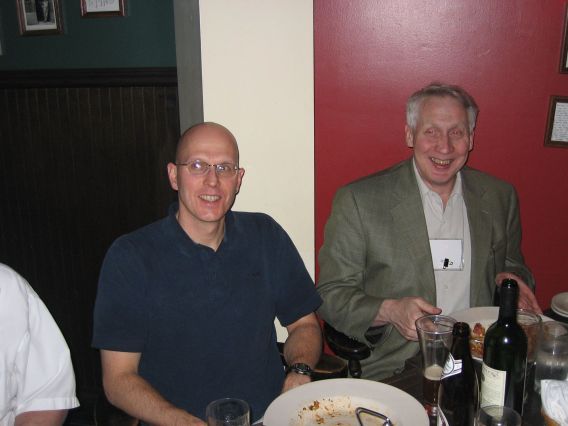
Mylan Engel Jr, whom I have known for more than 20 years, has accepted my invitation to join this blog. Mylan (on the left in this image) is Associate Professor of Philosophy (with tenure) at Northern Illinois University in DeKalb, Illinois. We met in graduate school at The University of Arizona. There is a link to Mylan's homepage on the left, in the Members area. You may also want to read his essay, "The Immorality of Eating Meat," a link to which appears (where else?) in the Links area. It is the best essay I've ever read on the moral status of nonhuman animals. Please spread the word about this blog. I hope Mylan's presence gives it new life.
Addendum: Mylan and I are committed to protecting the interests of nonhuman animals. You could say that we're animal liberationists. Perhaps it would be nice if I added someone who thinks the interests of animals may be discounted or disregarded. But Mylan and I are far from clones. I'm politically conservative; Mylan is a liberal. I'm a moral subjectivist; Mylan is an objectivist. I'm an egoist; Mylan is an altruist. I'm a dog lover; Mylan is a cat lover. I'm a demi-vegetarian; Mylan is a vegan. I think epistemology is dead; Mylan thinks it's alive and well. I hope our differences make for an interesting blog!
Addendum: Mylan and I are committed to protecting the interests of nonhuman animals. You could say that we're animal liberationists. Perhaps it would be nice if I added someone who thinks the interests of animals may be discounted or disregarded. But Mylan and I are far from clones. I'm politically conservative; Mylan is a liberal. I'm a moral subjectivist; Mylan is an objectivist. I'm an egoist; Mylan is an altruist. I'm a dog lover; Mylan is a cat lover. I'm a demi-vegetarian; Mylan is a vegan. I think epistemology is dead; Mylan thinks it's alive and well. I hope our differences make for an interesting blog!
02 March 2005
Don't Get on the Wrong Side of Bessie
See here. (Thanks to my bird-loving [but meat-eating] friend Peg Kaplan for the link.)
Addendum: See here.
Addendum: See here.
26 February 2005
Paul W. Taylor on Biocentrism
When a life-centered view is taken, the obligations and responsibilities we have with respect to the wild animals and plants of the Earth are seen to arise from certain moral relations holding between ourselves and the natural world itself. The natural world is not there simply as an object to be exploited by us, nor are its living creatures to be regarded as nothing more than resources for our use and consumption. On the contrary, wild communities of life are understood to be deserving of our moral concern and consideration because they have a kind of value that belongs to them inherently. Just as we would think it inappropriate to ask, What is a human being good for? because such a question seems to assume that the value or worth of a person is merely a matter of being useful as a means to some end, so the question, What is a wilderness good for? is likewise considered inappropriate from the perspective of a biocentric outlook. The living things of the natural world have a worth that they possess simply in virtue of their being members of the Earth’s Community of Life. Such worth does not derive from their actual or possible usefulness to humans, or from the fact that humans find them enjoyable to look at or interesting to study.
(Paul W. Taylor, Respect for Nature: A Theory of Environmental Ethics [Princeton: Princeton University Press, 1986], 12-3)
(Paul W. Taylor, Respect for Nature: A Theory of Environmental Ethics [Princeton: Princeton University Press, 1986], 12-3)
25 February 2005
From Today's New York Times
To the Editor:
I suppose we think it's bizarre that a century ago women wore dead birds on their hats and it was considered the height of fashion (Editorial Observer, Feb. 22). Yet look around, and you'll find women strutting down the avenue wrapped in the skins of dead mammals. The brutal feather trade is gone, but the brutal fur trade lives on.
Jane Shakman
Ossining, N.Y., Feb. 22, 2005
The writer is grass-roots coordinator, Westchester Animal Rights Activists.
I suppose we think it's bizarre that a century ago women wore dead birds on their hats and it was considered the height of fashion (Editorial Observer, Feb. 22). Yet look around, and you'll find women strutting down the avenue wrapped in the skins of dead mammals. The brutal feather trade is gone, but the brutal fur trade lives on.
Jane Shakman
Ossining, N.Y., Feb. 22, 2005
The writer is grass-roots coordinator, Westchester Animal Rights Activists.
24 February 2005
From Today's New York Times
To the Editor:
Re "Testing New Ban, Britons Run With the Hounds" (front page, Feb. 20):
Likening the ban on fox hunting with dogs in Britain to the end of a tradition should in no way mitigate the barbarity of this practice.
Just as slavery was once a tradition whose abolition was decried by many, so, too, is the vicious fox hunt another tradition that the world could surely do without.
Matthew A. MacDonald
Halifax, Nova Scotia, Feb. 20, 2005
Addendum: One of my readers sent a link to this.
Re "Testing New Ban, Britons Run With the Hounds" (front page, Feb. 20):
Likening the ban on fox hunting with dogs in Britain to the end of a tradition should in no way mitigate the barbarity of this practice.
Just as slavery was once a tradition whose abolition was decried by many, so, too, is the vicious fox hunt another tradition that the world could surely do without.
Matthew A. MacDonald
Halifax, Nova Scotia, Feb. 20, 2005
Addendum: One of my readers sent a link to this.
23 February 2005
19 February 2005
18 February 2005
14 February 2005
Animals
Many readers will not like my saying this, but there is more rationalization about meat-eating than about any other topic. I say that without the slightest exaggeration. I believe meat-eating violates most people’s moral principles, but they conspire in various ways to keep this uncomfortable fact from themselves. Why? Because they enjoy the taste of meat. That fact—taste—drives everything.
If animals matter at all, morally speaking, they win. Think about it. If animal suffering has any weight on the moral scale (i.e., if it weighs more than nothing), it outweighs your taste preferences. To hide this ugly fact, people pretend that animal suffering has no moral weight. Some people, such as René Descartes, have gone further and denied that animals are capable of suffering. Descartes said that animals are elaborately constructed (by God) robots: bêtes machines. But you don’t think that. You know that cows and pigs are subjected to horrible suffering to produce the flesh you so happily consume. Why does this suffering not matter to you? Do you live with a dog or a cat? Does your dog’s or cat’s suffering matter, morally? Why should one animal’s suffering matter morally but not another’s? Isn’t that like saying that white suffering counts for more than black suffering? The fact that you’re not inclined to eat your dog or cat, but are inclined to eat cows and pigs, doesn’t show that the suffering of cows and pigs doesn’t matter. It shows that you’re putting your own trivial interests ahead of their basic interests.
Don’t rail out at me. Don’t displace blame for your actions. Take responsibility for your actions. Live up to your moral principles, one of which, I assume, is that it’s wrong to inflict suffering on others. This means that unless there is a good moral reason to inflict suffering, it’s wrong to do so. Your taste preferences are not moral considerations. Saying that they are, or thinking that they are, is a rationalization. And even if your taste preferences have some moral weight, it is easily outweighed by animal suffering. To see this, suppose you had a taste for human flesh. How much human suffering would that justify?
If animals matter at all, morally speaking, they win. Think about it. If animal suffering has any weight on the moral scale (i.e., if it weighs more than nothing), it outweighs your taste preferences. To hide this ugly fact, people pretend that animal suffering has no moral weight. Some people, such as René Descartes, have gone further and denied that animals are capable of suffering. Descartes said that animals are elaborately constructed (by God) robots: bêtes machines. But you don’t think that. You know that cows and pigs are subjected to horrible suffering to produce the flesh you so happily consume. Why does this suffering not matter to you? Do you live with a dog or a cat? Does your dog’s or cat’s suffering matter, morally? Why should one animal’s suffering matter morally but not another’s? Isn’t that like saying that white suffering counts for more than black suffering? The fact that you’re not inclined to eat your dog or cat, but are inclined to eat cows and pigs, doesn’t show that the suffering of cows and pigs doesn’t matter. It shows that you’re putting your own trivial interests ahead of their basic interests.
Don’t rail out at me. Don’t displace blame for your actions. Take responsibility for your actions. Live up to your moral principles, one of which, I assume, is that it’s wrong to inflict suffering on others. This means that unless there is a good moral reason to inflict suffering, it’s wrong to do so. Your taste preferences are not moral considerations. Saying that they are, or thinking that they are, is a rationalization. And even if your taste preferences have some moral weight, it is easily outweighed by animal suffering. To see this, suppose you had a taste for human flesh. How much human suffering would that justify?
12 February 2005
From Today's New York Times
To the Editor:
Your Feb. 6 editorial "What Meat Means" indicts the United States meat industry in an outrageous manner.
Worker safety guidelines developed in 1990 by the American Meat Institute, in collaboration with government and union officials, have reduced injury and illness rates by two-thirds. Days lost due to work-related injuries dropped 220 percent.
Line speeds are a function of engineering assessments that assure that tasks can be safely performed in a prescribed period of time. That injury rates have been declining for a decade demonstrates that staffing levels are appropriate.
Meat packing has been a gateway industry for new Americans. That's because meat jobs pay more than twice the minimum wage and offer generous benefits, making these jobs highly desirable.
Department of Agriculture data show that bacteria on meat and poultry have declined substantially over the last decade. Those gains would not be possible if our systems are antiquated, as your editorial suggests.
J. Patrick Boyle
President and Chief Executive
American Meat Institute
Washington, Feb. 8, 2005
Your Feb. 6 editorial "What Meat Means" indicts the United States meat industry in an outrageous manner.
Worker safety guidelines developed in 1990 by the American Meat Institute, in collaboration with government and union officials, have reduced injury and illness rates by two-thirds. Days lost due to work-related injuries dropped 220 percent.
Line speeds are a function of engineering assessments that assure that tasks can be safely performed in a prescribed period of time. That injury rates have been declining for a decade demonstrates that staffing levels are appropriate.
Meat packing has been a gateway industry for new Americans. That's because meat jobs pay more than twice the minimum wage and offer generous benefits, making these jobs highly desirable.
Department of Agriculture data show that bacteria on meat and poultry have declined substantially over the last decade. Those gains would not be possible if our systems are antiquated, as your editorial suggests.
J. Patrick Boyle
President and Chief Executive
American Meat Institute
Washington, Feb. 8, 2005
11 February 2005
Twenty-Four and Counting
It's been 24 years—more than half my life—since I ate red meat. No cow, pig, sheep, or deer has suffered or died on my account.
09 February 2005
Vegetarianism
As I wrote the other day, vegetarianism is overdetermined. That is to say, there are multiple individually sufficient reasons to abstain from meat. If you care about animals, you should abstain from meat. If you care about the natural environment, you should abstain from meat. If you care about other human beings, you should abstain from meat. If you care about yourself, you should abstain from meat. See here for the book that demonstrates the adverse health effects of meat-eating. You can be sure that the meat industries will not like it. (Thanks to Khursh Acevedo for the link.)
06 February 2005
02 February 2005
31 January 2005
Conservatism and Animal Rights
I’m a conservative. I’m also a proponent of animal rights. I won’t say I’m a proponent of animal rights because I’m a conservative, the way Peter Singer says he’s a vegetarian because he’s a utilitarian, because that would imply a logical connection between them. I don’t think there’s any logical connection between conservatism and animal rights, or indeed between any political morality and animal rights. But they’re not incompatible, either. One can be a conservative and a proponent of animal rights or a conservative and an opponent of animal rights. That there are more of the latter than of the former is an accident.
Let me explain what I mean by “proponent of animal rights.” Animals matter. Morally. They have intrinsic moral significance, just like human beings (but unlike plants). Immanuel Kant famously denied that animals have intrinsic moral significance. If it’s wrong to treat animals in certain ways, he held, it’s not because the animal is wronged but because some human being who takes an interest in the animal is wronged. Utilitarians such as Jeremy Bentham say that it’s not rational agency that confers moral status on a being; it’s the capacity to suffer, and animals have the capacity to suffer.
I’m not a utilitarian, but I’m not a Kantian, either. I’m a nonKantian deontologist who believes that it’s wrong to harm others. Animals can be harmed. Their lives are valuable to them in the same way that your life is valuable to you. Why is it wrong for me to kill you? I suspect you will say that my killing you deprives you of your future, which contains enjoyments, experiences, projects, and activities. Animals such as dogs, cows, pigs, and chickens are capable of enjoyments, experiences, and activities, too, although perhaps not of having projects. If animals can suffer the same sorts of loss that you can, then if that loss makes it wrong to kill you, why doesn’t it make it wrong to kill an animal?
Why should my conservatism be thought to deny any of this? It might be said that conservatism is committed to conserving traditions, and that it’s traditional to treat animals as resources for human use. But no conservative endorses all tradition. Slavery is traditional. No conservative defends slavery. There must be a criterion for distinguishing those traditions that are worth preserving and those that are not. I suggest that the criterion involves harm to others. Slavery harmed slaves. That is why it need not and should not be conserved. But using animals for food and other purposes (entertainment, for example) harms them. That it’s traditional to so use them is therefore irrelevant. Bad traditions should be abolished, not conserved.
I’ve only sketched my argument. The main point of this post is that there is no logical incompatibility between being a conservative and being a proponent of animal rights. If there is, then I’m horribly confused.
Let me explain what I mean by “proponent of animal rights.” Animals matter. Morally. They have intrinsic moral significance, just like human beings (but unlike plants). Immanuel Kant famously denied that animals have intrinsic moral significance. If it’s wrong to treat animals in certain ways, he held, it’s not because the animal is wronged but because some human being who takes an interest in the animal is wronged. Utilitarians such as Jeremy Bentham say that it’s not rational agency that confers moral status on a being; it’s the capacity to suffer, and animals have the capacity to suffer.
I’m not a utilitarian, but I’m not a Kantian, either. I’m a nonKantian deontologist who believes that it’s wrong to harm others. Animals can be harmed. Their lives are valuable to them in the same way that your life is valuable to you. Why is it wrong for me to kill you? I suspect you will say that my killing you deprives you of your future, which contains enjoyments, experiences, projects, and activities. Animals such as dogs, cows, pigs, and chickens are capable of enjoyments, experiences, and activities, too, although perhaps not of having projects. If animals can suffer the same sorts of loss that you can, then if that loss makes it wrong to kill you, why doesn’t it make it wrong to kill an animal?
Why should my conservatism be thought to deny any of this? It might be said that conservatism is committed to conserving traditions, and that it’s traditional to treat animals as resources for human use. But no conservative endorses all tradition. Slavery is traditional. No conservative defends slavery. There must be a criterion for distinguishing those traditions that are worth preserving and those that are not. I suggest that the criterion involves harm to others. Slavery harmed slaves. That is why it need not and should not be conserved. But using animals for food and other purposes (entertainment, for example) harms them. That it’s traditional to so use them is therefore irrelevant. Bad traditions should be abolished, not conserved.
I’ve only sketched my argument. The main point of this post is that there is no logical incompatibility between being a conservative and being a proponent of animal rights. If there is, then I’m horribly confused.
30 January 2005
Cows with Guns
My friend Peg Kaplan sent a link to this. Peg should not be assumed to agree with its contents.
From Today's New York Times
To the Editor:
Our food habits could not be more dysfunctional. Food makers lobbying to edit national dietary standards is the tip of the iceberg.
Deciding what we grow and eat is now answered by large agribusinesses here and overseas, farm subsidies, chemical companies, genetic engineers and lobbyists.
The quickest change comes from our buying dollars.
Melanie Cheng
San Francisco, Jan. 26, 2005
Our food habits could not be more dysfunctional. Food makers lobbying to edit national dietary standards is the tip of the iceberg.
Deciding what we grow and eat is now answered by large agribusinesses here and overseas, farm subsidies, chemical companies, genetic engineers and lobbyists.
The quickest change comes from our buying dollars.
Melanie Cheng
San Francisco, Jan. 26, 2005
26 January 2005
Gratification #27
Dogs. Yes, dogs. I love dogs. They are loyal to a fault; they are playful and enthusiastic; their love for their human companions is unbounded and unconditional; they hold no grudges; they are patient; they appreciate little favors (as well as big ones); and they don’t care whether you’re a success or a failure in your work or in your love life—as long as you come home to them. Schopenhauer said that he would not want to live in a world without dogs. Neither would I. I have learned as much from my canine companions as I have from certain philosophers I could name. They teach me (by example); they inspire me; they entertain me; they fulfill me.
25 January 2005
Reasons for Vegetarianism
If you care about any of the following, you should abstain from meat:
Addendum: Philosophers often speak of overdetermination and underdetermination. Theory, they say, is underdetermined (by data). Vegetarianism is overdetermined. There are multiple sufficient reasons to abstain from meat.
• animalsThat’s right, humans. See here.
• the natural environment
• your health
• humans
Addendum: Philosophers often speak of overdetermination and underdetermination. Theory, they say, is underdetermined (by data). Vegetarianism is overdetermined. There are multiple sufficient reasons to abstain from meat.
24 January 2005
Sophie
I don’t know where the time went, but it’s been 12 years since I brought two-month-old Sophie to my house in Fort Worth. She was born in a horse barn in Red Oak, Texas. I’ve watched Sophie go from a rampaging puppy to a rambunctious middle-aged dog to an old girl who sleeps a lot, walks more slowly, and doesn’t hear as well. But one thing hasn’t changed: my love for her. We have been constant companions for a dozen years, with several more to go.
22 January 2005
From Today's New York Times
To the Editor:
Re "Mad Cow Across the Border" (editorial, some editions, Jan. 19):
Nearly 190,000 animals have been tested for bovine spongiform encephalopathy since June 2004 as part of an intensive Department of Agriculture surveillance program. None have tested positive. Even if additional cases of B.S.E. are discovered in the United States, scientists agree that B.S.E. is not a public health risk.
At least 82 percent of the cattle harvested in the United States are less than 30 months old. Current science says that B.S.E. develops only in cattle older than 30 months. The testing program targets these cattle. Testing all cattle would be like testing children for Alzheimer's disease. It is just not necessary.
As a rancher, a mother and a grandmother, I am confident in the safety of the beef I serve to my own family and to others around the nation.
Jan Lyons
President, National Cattlemen's Beef Association
Manhattan, Kan., Jan. 20, 2005
Re "Mad Cow Across the Border" (editorial, some editions, Jan. 19):
Nearly 190,000 animals have been tested for bovine spongiform encephalopathy since June 2004 as part of an intensive Department of Agriculture surveillance program. None have tested positive. Even if additional cases of B.S.E. are discovered in the United States, scientists agree that B.S.E. is not a public health risk.
At least 82 percent of the cattle harvested in the United States are less than 30 months old. Current science says that B.S.E. develops only in cattle older than 30 months. The testing program targets these cattle. Testing all cattle would be like testing children for Alzheimer's disease. It is just not necessary.
As a rancher, a mother and a grandmother, I am confident in the safety of the beef I serve to my own family and to others around the nation.
Jan Lyons
President, National Cattlemen's Beef Association
Manhattan, Kan., Jan. 20, 2005
19 January 2005
PETA
Here is the Wikipedia entry on People for the Ethical Treatment of Animals (PETA). Note that its neutrality is disputed. I haven't read the whole entry, but there are two possibilities. Either PETA supporters have made the entry too favorable to the organization or PETA opponents have made it too unfavorable. Or both. That the entry is disputed shows that animal rights remains a controversial topic in our society. This is not necessarily bad. John Stuart Mill (1806-1873) said that all great movements go through three stages: ridicule, discussion, and adoption. We're past the ridicule stage and into the discussion stage. Whether we get to the adoption stage remains to be seen. I hope we do. I'm working to increase the chance that we do.
Whole Foods Market
Ryan Gendron sent a link to this interview with John Mackey, who is the founder and chief executive officer of Whole Foods Market. Thanks, Ryan!
18 January 2005
From Today's New York Times
To the Editor:
Yes, processed-food manufacturers were issued a reprieve on trans fats from the Agriculture Department's dietary guidelines. But it bears mentioning that the meat and dairy industries also have a history of being shielded from scrutiny.
There is no dietary requirement for cholesterol whatsoever, and too much of it in our blood becomes a risk factor for deadly disease. Yet the guidelines give the allowance of 300 milligrams of dietary cholesterol per day, simply so people may eat foods of animal origin, the only foods that actually contain cholesterol. (Plants are free of cholesterol, and in fact supply phytosterols, which are good for human health.)
Interestingly, 300 milligrams don't go very far. A person handily uses up his or her entire U.S.D.A.-designated daily quota for cholesterol after consuming two small eggs. How many would believe that the government actually advises people to completely curtail meat and dairy intake after that limit has been reached?
Pamela Rice
New York, Jan. 13, 2005
The writer is the author of a book about vegetarianism.
Yes, processed-food manufacturers were issued a reprieve on trans fats from the Agriculture Department's dietary guidelines. But it bears mentioning that the meat and dairy industries also have a history of being shielded from scrutiny.
There is no dietary requirement for cholesterol whatsoever, and too much of it in our blood becomes a risk factor for deadly disease. Yet the guidelines give the allowance of 300 milligrams of dietary cholesterol per day, simply so people may eat foods of animal origin, the only foods that actually contain cholesterol. (Plants are free of cholesterol, and in fact supply phytosterols, which are good for human health.)
Interestingly, 300 milligrams don't go very far. A person handily uses up his or her entire U.S.D.A.-designated daily quota for cholesterol after consuming two small eggs. How many would believe that the government actually advises people to completely curtail meat and dairy intake after that limit has been reached?
Pamela Rice
New York, Jan. 13, 2005
The writer is the author of a book about vegetarianism.
17 January 2005
Categorizing Animals
Some animals are wild and some domesticated. Some domesticated animals are used as resources for human ends and some are cared for as family members. I believe our moral obligations differ depending on which category a particular animal belongs to. This is not ad hoc. I also believe that our moral obligations to humans differ depending on which category they belong to. I have obligations to my children, for example, that I have to no other child. I have obligations to Americans that I have to no other nationality. Here are the three categories:
1. Wild animals. Wild animals should be left alone. We should not hunt them, trap them, capture them for zoos or circuses, or displace them. Nor should we intervene to prevent predation. Saving one animal from another only starves the other. The relevant principle here is nonmaleficence (do no harm).Consequentialists deny the existence of special responsibilities. They say that any partiality toward those near and dear to one is impermissible. They also deny the moral significance of the distinction between harming and not preventing harm. If I allow you to die, they say, I am a murderer, even if I had nothing to do with your predicament. Many of us think that the failure to make these distinctions counts against consequentialism. For more on this subject, see my essay “Doing Right by Our Animal Companions,” a link to which appears on the left side of this blog.
2. Domesticated resource animals. Institutions such as factory farms, which treat animals as resources for human consumption, should be abolished. We should stop breeding cows, pigs, and chickens for their meat, eggs, hides, and other materials. The relevant principle here is nonmaleficence (do no harm).
3. Companions. Domesticated animals that we take into our homes, such as dogs and cats, have the status of children or friends. We have obligations not only to refrain from harming them (as we do to all animals), but to provide for their needs. The relevant principles here are nonmaleficence (do no harm) and beneficence (do good).
16 January 2005
From Today's New York Times
To the Editor:
Re "A 9,000-Pound Fish Out of Water, Alone in Alaska Since 2002" (Anchorage Journal, Jan. 9):
Friends of Maggie, an Anchorage citizens' group, has worked to persuade the Alaska Zoo to relocate its solitary female African elephant, Maggie, to a warm climate and the company of other elephants.
Four superb institutions are willing and able to give Maggie a spacious home with other female African elephants in a mild climate.
Female elephants are one of the most socially needy and complex land mammals on the planet. Outside captivity, they never live alone, and never live in the sub-Arctic.
Maggie could live 40 more years. Surely she deserves a better future than 40 years on a treadmill in a cement barn in Alaska.
Penelope Wells
Exec. Dir., Friends of Maggie
Anchorage, Jan. 10, 2005
Re "A 9,000-Pound Fish Out of Water, Alone in Alaska Since 2002" (Anchorage Journal, Jan. 9):
Friends of Maggie, an Anchorage citizens' group, has worked to persuade the Alaska Zoo to relocate its solitary female African elephant, Maggie, to a warm climate and the company of other elephants.
Four superb institutions are willing and able to give Maggie a spacious home with other female African elephants in a mild climate.
Female elephants are one of the most socially needy and complex land mammals on the planet. Outside captivity, they never live alone, and never live in the sub-Arctic.
Maggie could live 40 more years. Surely she deserves a better future than 40 years on a treadmill in a cement barn in Alaska.
Penelope Wells
Exec. Dir., Friends of Maggie
Anchorage, Jan. 10, 2005
13 January 2005
12 January 2005
Friedrich Nietzsche (1844-1900) on the Philosopher's Product
I believe that the vegetarians, with their prescription to eat less and more simply, are of more use than all the new moral systems taken together: a little exaggeration here is of no importance. There is no doubt that the future educators of mankind will also prescribe a stricter diet. One hopes to make modern men healthy by means of air, sun, habitation, travel, etc.—including medical stimuli and toxins. But nothing which would be difficult for man seems to be ordered any longer. The maxim seems to be: be healthy and ill in an agreeable and comfortable manner. Yet it is just this incessant lack of moderation in small matters, this lack of self-discipline, which finally becomes evident as universal haste and impotentia.
[S]o long as philosophers fail to muster the courage to seek a totally transformed regimen and to exhibit it by their own example, then they are of no consequence.
The philosopher's product is his life (which occupies the most important position, before his works). His life is his work of art, and every work of art is first turned toward the artist and then toward other men.
(Friedrich Nietzsche, "Philosophy in Hard Times," chap. 5 in Philosophy and Truth: Selections from Nietzsche's Notebooks of the Early 1870's, ed. and trans. Daniel Breazeale [Atlantic Highlands, NJ: Humanities Press International, 1990 (1979)], 99-123, at 106, 107, and 109 [notes written in 1873] [italics in original; footnotes omitted])
[S]o long as philosophers fail to muster the courage to seek a totally transformed regimen and to exhibit it by their own example, then they are of no consequence.
The philosopher's product is his life (which occupies the most important position, before his works). His life is his work of art, and every work of art is first turned toward the artist and then toward other men.
(Friedrich Nietzsche, "Philosophy in Hard Times," chap. 5 in Philosophy and Truth: Selections from Nietzsche's Notebooks of the Early 1870's, ed. and trans. Daniel Breazeale [Atlantic Highlands, NJ: Humanities Press International, 1990 (1979)], 99-123, at 106, 107, and 109 [notes written in 1873] [italics in original; footnotes omitted])
Demi-Vegetarianism
One of my readers, Peg Kaplan, asked what “demi-vegetarian” means. Good question, Peg! I’ll be happy to explain. I got the term from R. M. Hare, who used it in the title of an essay: “Why I Am Only a Demi-Vegetarian,” chap. 15 in his Essays on Bioethics (Oxford: Clarendon Press, 1993), 219-35. According to Hare (who says he did not invent the term), a demi-vegetarian is “someone who, while not being a full vegetarian, let alone vegan, eats little meat, and is careful what kinds of meat he (or she) eats” (pages 224-5). Hare wrote that he and his wife ate little or no meat at home (except when hosting guests whom they knew—or guessed—would not like a vegetarian meal) and occasionally ate meat in restaurants when there was “no obvious alternative” (page 225).
The prefix “demi” means half, or, in this context, imperfect. So a demi-vegetarian is someone who is imperfectly vegetarian. We might say “almost vegetarian.” As in the case of vegetarianism proper, the regimen can be for dietary or moral reasons, or both.
Now to my own diet. I learned when I was 15 years old that I was allergic to dairy products. Since then (1972), I’ve consumed no milk, cheese, butter, ice cream, or yogurt. I gave up red meat (beef, pork, lamb, venison, &c) in 1981, nearly a quarter of a century ago. That left only turkey, chicken, fish, and eggs in my diet, as far as animal products go. I gave up turkey in 1982, leaving chicken, fish, and eggs. That’s where it stood for many years. Finally, a couple of years ago, I gave up chicken, although if something I buy (such as ramen) is made with chicken stock, I will eat it. Also two years ago, I began buying eggs from free-roaming hens. So, for about two years, the only animal products I’ve consumed are fish (sardines, for example, but also frozen fish) and free-range eggs. It would be dishonest of me to call myself a vegetarian, and I never have, at least without immediately qualifying what I mean. I’m almost a vegetarian. I’m a demi-vegetarian.
The prefix “demi” means half, or, in this context, imperfect. So a demi-vegetarian is someone who is imperfectly vegetarian. We might say “almost vegetarian.” As in the case of vegetarianism proper, the regimen can be for dietary or moral reasons, or both.
Now to my own diet. I learned when I was 15 years old that I was allergic to dairy products. Since then (1972), I’ve consumed no milk, cheese, butter, ice cream, or yogurt. I gave up red meat (beef, pork, lamb, venison, &c) in 1981, nearly a quarter of a century ago. That left only turkey, chicken, fish, and eggs in my diet, as far as animal products go. I gave up turkey in 1982, leaving chicken, fish, and eggs. That’s where it stood for many years. Finally, a couple of years ago, I gave up chicken, although if something I buy (such as ramen) is made with chicken stock, I will eat it. Also two years ago, I began buying eggs from free-roaming hens. So, for about two years, the only animal products I’ve consumed are fish (sardines, for example, but also frozen fish) and free-range eggs. It would be dishonest of me to call myself a vegetarian, and I never have, at least without immediately qualifying what I mean. I’m almost a vegetarian. I’m a demi-vegetarian.
11 January 2005
From Today's New York Times
To the Editor:
In "Live Free and Die" (Op-Ed, Jan. 4), Judy Blunt portrays the issue of what to do about overpopulation and starvation of wild horses to benefit those who stand to profit from their slaughter.
Senator Conrad Burns, Republican of Montana, added language into last year's spending bill allowing certain horses to be auctioned to the highest bidder, which may be a slaughterhouse. This lifted more than 30 years of protection for our wild herds.
Immunocontraception has been successful in controlling the populations of these animals. They should be moved to sanctuaries or protected areas where their numbers can be humanely controlled. Slaughter should never be an option.
The majority of Americans oppose the slaughter of horses and their export abroad for human consumption. It goes against our culture and has been illegal in California since 1998.
Wild horses and burros were being protected because the American people demanded it. Perhaps Representative John E. Sweeney of New York, who heads the Congressional Horse Caucus, will lead the way to repeal Senator Burns's disastrous legislation.
Susan Wagner
President, Equine Advocates
Chatham, N.Y., Jan. 4, 2005
In "Live Free and Die" (Op-Ed, Jan. 4), Judy Blunt portrays the issue of what to do about overpopulation and starvation of wild horses to benefit those who stand to profit from their slaughter.
Senator Conrad Burns, Republican of Montana, added language into last year's spending bill allowing certain horses to be auctioned to the highest bidder, which may be a slaughterhouse. This lifted more than 30 years of protection for our wild herds.
Immunocontraception has been successful in controlling the populations of these animals. They should be moved to sanctuaries or protected areas where their numbers can be humanely controlled. Slaughter should never be an option.
The majority of Americans oppose the slaughter of horses and their export abroad for human consumption. It goes against our culture and has been illegal in California since 1998.
Wild horses and burros were being protected because the American people demanded it. Perhaps Representative John E. Sweeney of New York, who heads the Congressional Horse Caucus, will lead the way to repeal Senator Burns's disastrous legislation.
Susan Wagner
President, Equine Advocates
Chatham, N.Y., Jan. 4, 2005
09 January 2005
Peter Singer’s Influence
It’s been 30 years since Animal Liberation was published. I don’t know how many times I’ve heard or read about its influence, which is said to be significant. But where’s the evidence for this? Has anyone done a study? And how much influence is a lot of influence? Is it influential as philosophy books go, as books about animals go, as books about animal ethics go, or as books in general go? And how much of the book’s influence is due to its argumentation, as opposed to the emotional wallop packed by its images and descriptions of how animals are used in laboratories and on factory farms? If all or most of the book’s influence is due to emotional factors, then neither Singer nor his philosophical colleagues can take pride in the fact that it was written by a philosopher; for another book that had the same images and descriptions—but not the arguments—would have had the same effect.
Philosophers are usually careful in making factual claims, since they have no factual expertise, but for some reason (self-interest?) they take liberties when it comes to making claims about the influence of this or that philosophical work. How influential has John Rawls’s A Theory of Justice been, either popularly or professionally? Nobody knows! We need a society or a discipline that measures such things by strict empirical standards—and publishes the results. By the way, I’m not suggesting that the worth of a philosophical work (or any other scholarly work) lies solely, or even largely, in its impact on nonphilosophers. But when self-serving claims are made that philosophical works such as Animal Liberation have had significant extraphilosophical influence, I’m skeptical. Let’s see the evidence.
Philosophers are usually careful in making factual claims, since they have no factual expertise, but for some reason (self-interest?) they take liberties when it comes to making claims about the influence of this or that philosophical work. How influential has John Rawls’s A Theory of Justice been, either popularly or professionally? Nobody knows! We need a society or a discipline that measures such things by strict empirical standards—and publishes the results. By the way, I’m not suggesting that the worth of a philosophical work (or any other scholarly work) lies solely, or even largely, in its impact on nonphilosophers. But when self-serving claims are made that philosophical works such as Animal Liberation have had significant extraphilosophical influence, I’m skeptical. Let’s see the evidence.
08 January 2005
From the Mailbag
Hi there
Your blog is exactly what I need right now and I hope you—or someone—can help me with an ethical dilemma regarding my one-year-old dog.
I am in a position of having to chose one life over another. My dog has recently killed some of my ducks and it seems that this may be next to impossible to switch off in him. Some of the training/rehabilitating already taken place seemed extremely effective until he ate another one, in spite of close supervision. I have had indications that he could go after our cats in a predatory way.
The dilemma is multifold. First—I have been in discussion with trainers all over the world (literally—I love this dog). The general consensus is that at best, I can hopefully "manage" the behaviour but the likelihood is that if he has the opportunity (or can take the opportunity) he will kill again. However, he is a perfect dog in most other respects. So, what I am wondering is, what steps do I need to take in order to arrive at an ethical decision?
I did take some ethics, but right now, I could use a bit of back up!
Thanks
Colleen
Your blog is exactly what I need right now and I hope you—or someone—can help me with an ethical dilemma regarding my one-year-old dog.
I am in a position of having to chose one life over another. My dog has recently killed some of my ducks and it seems that this may be next to impossible to switch off in him. Some of the training/rehabilitating already taken place seemed extremely effective until he ate another one, in spite of close supervision. I have had indications that he could go after our cats in a predatory way.
The dilemma is multifold. First—I have been in discussion with trainers all over the world (literally—I love this dog). The general consensus is that at best, I can hopefully "manage" the behaviour but the likelihood is that if he has the opportunity (or can take the opportunity) he will kill again. However, he is a perfect dog in most other respects. So, what I am wondering is, what steps do I need to take in order to arrive at an ethical decision?
I did take some ethics, but right now, I could use a bit of back up!
Thanks
Colleen
07 January 2005
From Today's New York Times
To the Editor:
Judy Blunt takes aim not only at free-roaming horses and burros but also at the defenders of wild horses, whose positions she caricatures ("Live Free and Die," Op-Ed, Jan. 4).
It is fatuous to argue that 30,000 wild horses roaming the West are degrading the region's arid lands when there are more than four million livestock grazing on those same lands.
Her claim that livestock grazing is "under strict regulations" is laughable.
Groups like the Humane Society of the United States have advocated for fewer roundups of horses and helped develop a contraceptive vaccine as a centerpiece of an active, nonlethal management strategy.
Where population reductions are well justified, nonlethal strategies like contraception should take the place of costly roundups, which are now just an antecedent to the slaughter of horses for export to foreign markets for human consumption.
Wayne Pacelle
President and Chief Executive
Humane Society of the U.S.
Washington, Jan. 4, 2005
Judy Blunt takes aim not only at free-roaming horses and burros but also at the defenders of wild horses, whose positions she caricatures ("Live Free and Die," Op-Ed, Jan. 4).
It is fatuous to argue that 30,000 wild horses roaming the West are degrading the region's arid lands when there are more than four million livestock grazing on those same lands.
Her claim that livestock grazing is "under strict regulations" is laughable.
Groups like the Humane Society of the United States have advocated for fewer roundups of horses and helped develop a contraceptive vaccine as a centerpiece of an active, nonlethal management strategy.
Where population reductions are well justified, nonlethal strategies like contraception should take the place of costly roundups, which are now just an antecedent to the slaughter of horses for export to foreign markets for human consumption.
Wayne Pacelle
President and Chief Executive
Humane Society of the U.S.
Washington, Jan. 4, 2005
06 January 2005
Peter Singer
I found this story about Peter Singer while surfing the Internet. Like most leftists, he can't believe that an intelligent person can be religious. This shows how detached he is from reality. Religion has nothing to do with intelligence. It has everything to do with finding meaning in life.
Addendum: Notice how Singer keeps saying that such-and-such an act is not "inherently" or "intrinsically" wrong. This implies that he thinks some acts are intrinsically wrong, i.e., wrong in themselves, because of the kinds of act they are. He doesn't. Singer is a consequentialist. That an act is of a certain type, e.g., homicide, torture, incest, bestiality, adultery, lying, or breaking a promise, is morally irrelevant to him. The only thing that matters, to a consequentialist, is an act's consequences. If an act of homicide or torture brings about the best overall consequences (which, logically, it could), it is right. If an act of keeping a promise or telling the truth doesn't bring about the best overall consequences, it is wrong. What Princeton University needs in order to counter Singer's teaching is not a religious ethicist, as Marvin Olasky suggests, but a deontologist, someone for whom the type of act one performs is morally relevant. Not all religious ethicists are deontologists and not all deontologists are religious.
By the way, I find Singer's recourse to consent interesting. Consent is a deontological concept. It is linked to rights-possession, which Singer, qua consequentialist, disavows. If a particular act brings about the best overall consequences, it is irrelevant that not everyone affected by the act consents to it. Put differently, if consent has moral significance, then people cannot be used as mere means to collective ends as Singer wishes. As this shows, Singer is not only a bad philosopher; he's a bad consequentialist. Sometimes he appears not to understand his own theory.
Addendum: Notice how Singer keeps saying that such-and-such an act is not "inherently" or "intrinsically" wrong. This implies that he thinks some acts are intrinsically wrong, i.e., wrong in themselves, because of the kinds of act they are. He doesn't. Singer is a consequentialist. That an act is of a certain type, e.g., homicide, torture, incest, bestiality, adultery, lying, or breaking a promise, is morally irrelevant to him. The only thing that matters, to a consequentialist, is an act's consequences. If an act of homicide or torture brings about the best overall consequences (which, logically, it could), it is right. If an act of keeping a promise or telling the truth doesn't bring about the best overall consequences, it is wrong. What Princeton University needs in order to counter Singer's teaching is not a religious ethicist, as Marvin Olasky suggests, but a deontologist, someone for whom the type of act one performs is morally relevant. Not all religious ethicists are deontologists and not all deontologists are religious.
By the way, I find Singer's recourse to consent interesting. Consent is a deontological concept. It is linked to rights-possession, which Singer, qua consequentialist, disavows. If a particular act brings about the best overall consequences, it is irrelevant that not everyone affected by the act consents to it. Put differently, if consent has moral significance, then people cannot be used as mere means to collective ends as Singer wishes. As this shows, Singer is not only a bad philosopher; he's a bad consequentialist. Sometimes he appears not to understand his own theory.
05 January 2005
Ambrose Bierce
Circus, n. A place where horses, ponies and elephants are permitted to see men, women and children acting the fool.
(Ambrose Bierce, The Devil's Dictionary, c. 1911)
(Ambrose Bierce, The Devil's Dictionary, c. 1911)
03 January 2005
A Snippet of Dialogue
Arthur: Sentience—the capacity to suffer—marks the limit of moral considerability. If a being is sentient, its suffering must be taken into account in our deliberations. Nonsentient beings such as rocks and plants have no interests, so there is nothing to be taken into account.
Betty: What about insects and oysters? Are they sentient?
Arthur: If they are, their suffering must be taken into account. If not, not.
Betty: But are they sentient?
Arthur: That’s a factual question about which reasonable people can differ. Don’t confuse the category with its members. Just because it’s not clear whether a particular being goes in the sentient category doesn’t mean (1) that the category itself is unclear or (2) that there is no difference, after all, between being sentient and being nonsentient. Compare baldness. Everyone, logically speaking, is either bald or nonbald, but there are individuals who are not easily classified. That there are hard cases doesn’t entail that there are no easy cases. That a concept is not perfectly clear doesn’t entail that it’s perfectly unclear. Some people are clearly bald. Some people are clearly nonbald. Some people are neither clearly bald nor clearly nonbald.
Betty: But how can you use a category or concept—sentience—if it doesn’t allow all individuals to be easily classified?
Arthur: Easily. The animals we use as mere means to our ends—cows, pigs, chickens, turkeys, rats, monkeys—are clearly sentient. They’re not borderline cases. Why should the fact that there are other animals of doubtful sentience, such as oysters or insects, obscure this fact from us? Is a concept useful only if it is perfectly clear, i.e., only if it has no degree of vagueness? Most ordinary concepts are vague to some extent, but they remain useful to us. The concept of an automobile is useful, but there are hard cases of automobiles where we’re not sure whether to say, “Yes, it’s an automobile” or “No, it’s not an automobile.”
Betty: My head hurts. Good night.
Arthur: Good night.
Betty: What about insects and oysters? Are they sentient?
Arthur: If they are, their suffering must be taken into account. If not, not.
Betty: But are they sentient?
Arthur: That’s a factual question about which reasonable people can differ. Don’t confuse the category with its members. Just because it’s not clear whether a particular being goes in the sentient category doesn’t mean (1) that the category itself is unclear or (2) that there is no difference, after all, between being sentient and being nonsentient. Compare baldness. Everyone, logically speaking, is either bald or nonbald, but there are individuals who are not easily classified. That there are hard cases doesn’t entail that there are no easy cases. That a concept is not perfectly clear doesn’t entail that it’s perfectly unclear. Some people are clearly bald. Some people are clearly nonbald. Some people are neither clearly bald nor clearly nonbald.
Betty: But how can you use a category or concept—sentience—if it doesn’t allow all individuals to be easily classified?
Arthur: Easily. The animals we use as mere means to our ends—cows, pigs, chickens, turkeys, rats, monkeys—are clearly sentient. They’re not borderline cases. Why should the fact that there are other animals of doubtful sentience, such as oysters or insects, obscure this fact from us? Is a concept useful only if it is perfectly clear, i.e., only if it has no degree of vagueness? Most ordinary concepts are vague to some extent, but they remain useful to us. The concept of an automobile is useful, but there are hard cases of automobiles where we’re not sure whether to say, “Yes, it’s an automobile” or “No, it’s not an automobile.”
Betty: My head hurts. Good night.
Arthur: Good night.
02 January 2005
Singer on Posner on Catastrophe
Peter Singer and Richard Posner are two of our most prominent public intellectuals. Posner has a real job (federal appellate judge) that keeps him grounded, whereas Singer, a philosopher, takes flights of intellectual fancy. Posner is a pragmatist. Singer is a consequentialist. Both can (and do) claim John Stuart Mill (1806-1873) as a forebear: Posner for Mill's classical liberalism (see On Liberty [1859]) and Singer for Mill's utilitarianism (see Utilitarianism [1861]). (This, better than anything, shows the tension in Mill's thought.) Here is Singer's review of Posner's latest book: Catastrophe: Risk and Response. (Thanks to Bob Hessen for letting me know that the review was going to appear, or else I might not have found it.) By the way, if you're interested in the moral status of animals, as you should be, you will enjoy this dialogue between Singer and Posner.
30 December 2004
Gary L. Francione on Animal Property
Although animal rights may be a remote goal in a nation that still disregards the rights of the poor, of women, of people of color, and of children and the elderly, there can be little, if any, doubt that conventional morality strongly proscribes the infliction of any “unnecessary” pain on animals and imposes an obligation of [sic] all humans to treat nonhumans “humanely.” Despite ubiquitous agreement on these points, there is also widespread acknowledgment that animal abuse does continue unabated in our society. What accounts for this ostensible irony is that animals do not have rights under the law. There are, of course, many laws on the federal and state levels that purport to protect animals from “inhumane” treatment, but these laws do not really confer rights in the sense that we usually use that term. Indeed, the vast majority of these laws do not even prohibit certain types of conduct that adversely affects animals. To the extent that the law does contain any types of prohibitions, such as the illegality of dogfighting or cockfighting, these prohibitions are usually more concerned with class issues or other moral issues than with animal protection. Similarly, aggressive efforts by police to prohibit the use of animals in religious “sacrifices” may have more to do with racist attitudes about the religion involved than with concern about animals. Both dogfighting and cockfighting are activities that are ostensibly more common among members of disempowered minority communities. Although these prohibitions also appear to be related to a general social disapproval of gambling, other animal wagering activities (e.g., horseracing) are more common among the middle and upper classes; indeed, several such events, such as the Kentucky Derby, are quite celebrated. Prohibitions (e.g., no animal can be used in burn experiments) may imply that there are some interests possessed by the animal that may not be traded away simply because of consequential considerations (e.g., the animal has an interest in not being used in burn experiments even where it can be plausibly argued that humans will benefit). Animals are the property of people, and property owners usually react rather strongly against any measure that threatens their autonomy concerning the use of their property.
(Gary L. Francione, Animals, Property, and the Law, Ethics and Action, ed. Tom Regan [Philadelphia: Temple University Press, 1995], 17-8 [italics in original; endnote omitted])
(Gary L. Francione, Animals, Property, and the Law, Ethics and Action, ed. Tom Regan [Philadelphia: Temple University Press, 1995], 17-8 [italics in original; endnote omitted])
29 December 2004
27 December 2004
Robert Nozick (1938-2002) on the Moral Status of Animals
If some animals count for something, which animals count, how much do they count, and how can this be determined? Suppose (as I believe the evidence supports) that eating animals is not necessary for health and is not less expensive than alternate equally healthy diets available to people in the United States. The gain, then, from the eating of animals is pleasures of the palate, gustatory delights, varied tastes. I would not claim that these are not truly pleasant, delightful, and interesting. The question is: do they, or rather does the marginal addition in them gained by eating animals rather than only nonanimals, outweigh the moral weight to be given to animals’ lives and pain? Given that animals are to count for something, is the extra gain obtained by eating them rather than nonanimal products greater than the moral cost?
(Robert Nozick, Anarchy, State, and Utopia [New York: Basic Books, 1974], 36-7 [italics in original])
Addendum: See here for Peter Singer's contemporaneous review of Nozick's book.
(Robert Nozick, Anarchy, State, and Utopia [New York: Basic Books, 1974], 36-7 [italics in original])
Addendum: See here for Peter Singer's contemporaneous review of Nozick's book.
20 December 2004
Understanding Speciesism
Racism can be understood as the view that race (racial membership) has intrinsic moral significance, i.e., that race is a morally salient category. Nonracism denies that. Nonracists say that race has no intrinsic moral significance. If race has any moral significance at all, they say, it is because race is correlated with other traits that do have intrinsic moral significance. That is to say, race has, at most, extrinsic moral significance.
Speciesism is analogous to racism. Speciesists hold that species (species membership) has intrinsic moral significance, i.e., that species is a morally salient category. Nonspeciesism denies that. Nonspeciesists say that species membership has no intrinsic moral significance. If species has any moral significance at all, they say, it is because species is correlated with other traits that do have intrinsic moral significance. That is, species has, at most, extrinsic moral significance.
Nonspeciesism is compatible with differential treatment for members of different species. Suppose I have to choose between a human being and a dog, as in a lifeboat situation. I may choose the human being, but that choice doesn’t make me a speciesist. Whether I’m a speciesist depends not on what I choose, or do, but on the basis or rationale of my choice. If I choose the human being because he or she is a human being, I’m a speciesist. If I choose the human being because he or she has a greater expected lifespan, a higher quality of life, or more dependents who will be adversely affected by his or her death, or because the human being is my child or friend, I’m not a speciesist.
This shows the fallacy of thinking that concern for animals necessarily reduces one’s concern for humans. One can be nonspeciesist simply by refusing to treat biological humanity (membership in Homo sapiens) as a morally salient category. If humans are special, morally, it’s because of other traits, not because they’re human. Incidentally, both Peter Singer and Tom Regan, the founders of the modern animal-rights/animal-liberation movement, would choose the human being in the hypothetical case I described. But neither of them is a speciesist.
Speciesism is analogous to racism. Speciesists hold that species (species membership) has intrinsic moral significance, i.e., that species is a morally salient category. Nonspeciesism denies that. Nonspeciesists say that species membership has no intrinsic moral significance. If species has any moral significance at all, they say, it is because species is correlated with other traits that do have intrinsic moral significance. That is, species has, at most, extrinsic moral significance.
Nonspeciesism is compatible with differential treatment for members of different species. Suppose I have to choose between a human being and a dog, as in a lifeboat situation. I may choose the human being, but that choice doesn’t make me a speciesist. Whether I’m a speciesist depends not on what I choose, or do, but on the basis or rationale of my choice. If I choose the human being because he or she is a human being, I’m a speciesist. If I choose the human being because he or she has a greater expected lifespan, a higher quality of life, or more dependents who will be adversely affected by his or her death, or because the human being is my child or friend, I’m not a speciesist.
This shows the fallacy of thinking that concern for animals necessarily reduces one’s concern for humans. One can be nonspeciesist simply by refusing to treat biological humanity (membership in Homo sapiens) as a morally salient category. If humans are special, morally, it’s because of other traits, not because they’re human. Incidentally, both Peter Singer and Tom Regan, the founders of the modern animal-rights/animal-liberation movement, would choose the human being in the hypothetical case I described. But neither of them is a speciesist.
From the Mailbag
Hi Keith!
It's the president of your Luxembourg fan club again, whom you converted to vegetarianism some months ago. As regards dog food, what about feeding them with minced roadkill? I suppose there's a law against it, but I don't see what harm it could do. Or perhaps there isn't enough roadkill around.
Is there a "vegetarian ethics" stance on this?
Cheers,
Cathal Copeland
P.S. If you wish to publish this letter, feel free to do so!
It's the president of your Luxembourg fan club again, whom you converted to vegetarianism some months ago. As regards dog food, what about feeding them with minced roadkill? I suppose there's a law against it, but I don't see what harm it could do. Or perhaps there isn't enough roadkill around.
Is there a "vegetarian ethics" stance on this?
Cheers,
Cathal Copeland
P.S. If you wish to publish this letter, feel free to do so!
17 December 2004
Charles S. Nicoll and Sharon M. Russell on Vegetarianism
The vegetarian lifestyle is clearly not “cruelty free,” as animal activists wish to believe. There is no such thing as a bloodless veggieburger. The difference between vegetarian and omnivorous lifestyles is simply that in the former, the killing of animals is indirect and unintentional, and animals are not intentionally consumed. We fail to see how that makes vegetarianism morally more acceptable than being omnivorous.
(Charles S. Nicoll and Sharon M. Russell, “The Unnatural Nature of the Animal Rights/Liberation Philosophy,” Proceedings of the Society for Experimental Biology and Medicine 205 [1994]: 269-73, at 270)
(Charles S. Nicoll and Sharon M. Russell, “The Unnatural Nature of the Animal Rights/Liberation Philosophy,” Proceedings of the Society for Experimental Biology and Medicine 205 [1994]: 269-73, at 270)
13 December 2004
BHL
I discovered Barry Holstun Lopez 24 years ago today. It changed my life. See here if you want to be transformed.
12 December 2004
From the Mailbag
Keith,
Redwood, a British company, has also great vegan cheese assortment, including Edammer and Gouda style. As a Dutch man I know these things, of course.
See for example here.
I don't know if it is available in the US but first it wasn't in the Netherlands, but then people started to ask for it and now it is available. Good stuff.
Met vriendelijke groet,
Danny Friedmann
Amsterdam
Redwood, a British company, has also great vegan cheese assortment, including Edammer and Gouda style. As a Dutch man I know these things, of course.
See for example here.
I don't know if it is available in the US but first it wasn't in the Netherlands, but then people started to ask for it and now it is available. Good stuff.
Met vriendelijke groet,
Danny Friedmann
Amsterdam
Humans and Animals
Someone wrote to me to ask whether I’m as concerned about human rights as I am about animal rights. He said that, in his experience, those who believe that animals have rights tend to “humanize animals and dehumanize humans.” I don’t speak for others, obviously, but I don’t know of any philosopher (including me) whose concern for animals in any way undercuts his or her concern for humans. Peter Singer, for example, is as devoted to human beings as he is to animals. This is why he believes it wrong to allow human beings to suffer and die when one can easily prevent it. See here. Many people who claim to care about human beings would not go that far. There is, in short, no incompatibility between caring for humans and caring for animals; nor do I know of any psychological mechanism that suggests that caring is a zero-sum game. (If it’s possible to be nonracist, why isn’t it possible to be nonspeciesist?) If anything, those who care about animals care more about humans than those who care only about humans.
09 December 2004
Grilled Cheese Sandwiches
In 1972, when I was 15, I discovered that I was allergic to dairy products. They were causing (or aggravating) my asthma. For the past 32 years, I’ve had no milk, butter, ice cream, or cheese. The only thing I’ve missed during this time is cheese, especially cheddar. A few years ago, my local grocery store (Kroger) began to carry fake cheese, made from soybeans. It’s very good. Here is the brand I eat. It’s available in cheddar, jalapeno cheddar, pepper jack, American slices, and other varieties.
The other day, while watching television, I happened upon a story about a New York City diner that specializes in grilled cheese sandwiches. The sandwiches looked delicious. I remembered eating grilled cheese sandwiches as a child. Then it hit me: I can eat grilled cheese sandwiches, provided I use fake cheese rather than real cheese. Unfortunately, I had forgotten how to make them. So I called my mother in Michigan. She told me to put margarine on the outside of the bread rather than in the frying pan. Within minutes, I was eating an old favorite. Thanks, Mom! Thanks, television! But now I have another problem: resisting the temptation to eat grilled cheese sandwiches every day.
The other day, while watching television, I happened upon a story about a New York City diner that specializes in grilled cheese sandwiches. The sandwiches looked delicious. I remembered eating grilled cheese sandwiches as a child. Then it hit me: I can eat grilled cheese sandwiches, provided I use fake cheese rather than real cheese. Unfortunately, I had forgotten how to make them. So I called my mother in Michigan. She told me to put margarine on the outside of the bread rather than in the frying pan. Within minutes, I was eating an old favorite. Thanks, Mom! Thanks, television! But now I have another problem: resisting the temptation to eat grilled cheese sandwiches every day.
08 December 2004
From the Mailbag
Dr Burgess-Jackson
Just a quick thought about feeding meat to your dogs.
Several studies have pointed out that were we to convert all our farming to organic methods, we would have to convert large areas to producing cattle feed, and raise cattle anyway to produce sufficient amounts of organic fertilizer.
Today, milk cattle are converted to pet-food products when they no longer can produce enough milk.
Would the same cattle raised to produce organic fertilizer be similarly converted when their output of fertilizer dropped?
Oh yes, this message was delayed by Feisty and Bacho (the Aussie Sheep dog and the Beagle) who suddenly wanted to play a short game of "Pet me first—No pet ME first." (They taught me that game early on.)
Being pack animals, dogs NEED the pack experience with their owners (or servants), just as much as they need proper food.
Cheers
Frank Borger
Just a quick thought about feeding meat to your dogs.
Several studies have pointed out that were we to convert all our farming to organic methods, we would have to convert large areas to producing cattle feed, and raise cattle anyway to produce sufficient amounts of organic fertilizer.
Today, milk cattle are converted to pet-food products when they no longer can produce enough milk.
Would the same cattle raised to produce organic fertilizer be similarly converted when their output of fertilizer dropped?
Oh yes, this message was delayed by Feisty and Bacho (the Aussie Sheep dog and the Beagle) who suddenly wanted to play a short game of "Pet me first—No pet ME first." (They taught me that game early on.)
Being pack animals, dogs NEED the pack experience with their owners (or servants), just as much as they need proper food.
Cheers
Frank Borger
07 December 2004
From the Mailbag
Hello Dr. Burgess-Jackson,
I read your latest blog entry about your dogs. [See here.] Your dilemma cries out for an empirical approach. Feed your dogs vegan dog food for a few weeks and see what happens. Do they lose their appetite, or perhaps eat with less gusto than usual? Do they become listless and whiny? Does their fur start to fall out?
If you're not willing to conduct the experiment, I would at least be interested in hearing your thoughts about how, exactly, vegan dog food is purported to cause harm to dogs. Is the harm physical (i.e., malnutrition of some kind), psychological, or some combination of both? Surely there must be some data on this subject.
Regards,
Alex Chernavsky
I read your latest blog entry about your dogs. [See here.] Your dilemma cries out for an empirical approach. Feed your dogs vegan dog food for a few weeks and see what happens. Do they lose their appetite, or perhaps eat with less gusto than usual? Do they become listless and whiny? Does their fur start to fall out?
If you're not willing to conduct the experiment, I would at least be interested in hearing your thoughts about how, exactly, vegan dog food is purported to cause harm to dogs. Is the harm physical (i.e., malnutrition of some kind), psychological, or some combination of both? Surely there must be some data on this subject.
Regards,
Alex Chernavsky
Misunderstanding Peter Singer
I finally got around to reading Richard A. Posner’s book Public Intellectuals: A Study of Decline (Cambridge: Harvard University Press, 2001). Although I admire Posner greatly and always learn from him, I find that he treats certain people and subjects cavalierly. For example, here is what he says about Peter Singer:
If you read Animal Liberation carefully, you’ll see that Singer is making a simple and uncontroversial point: that like interests should be treated alike. This is an application of Aristotle’s dictum that justice consists in treating like cases alike and different cases differently. Suppose you’re dealing with two humans whose interests are the same. Justice requires that you neither disregard nor discount either person’s interests. Singer calls this principle the Principle of Equal Consideration of Interests (PECI). It’s a formal principle, not a material principle. It doesn’t tell us what interests there are, only how equal interests must be treated.
Obviously, each of us has many interests, the main one being the interest in not suffering. Let us call beings who have the capacity to suffer “sentient beings.” You and I are sentient beings. Cows, pigs, turkeys, and chickens are sentient. Trees and other plants are not. Rocks and dirt are not. Since cows, pigs, turkeys, chickens, and other animals are sentient, and since suffering is intrinsically bad (you believe that, don’t you?), every sentient being has an interest in not suffering. Trees, plants, rocks, and dirt, not being sentient, cannot suffer (by definition), and therefore have no interest in not suffering. Indeed, they have no interests at all. Nothing matters to them. Sentience appears to be a necessary condition for having interests, and, since being sentient gives one at least the interest in not suffering, it is also a sufficient condition. The class of sentient beings is the same class as (i.e., is coextensive with) the class of beings with interests.
All Singer demands, in Animal Liberation, is that, when we act, we take all relevant interests into account and consider them equally. We must neither disregard nor discount relevant interests. But disregarding and discounting routinely occur with respect to animals’ interest in not suffering. Humans inflict terrible suffering on animals for little or no reason, often just because they like the taste of their flesh. (I refer here to factory farms, where most meat, including, I suspect, all the meat you consume, originates.) That this disregards the animals’ interest in not suffering can be seen by the fact that we would not inflict any amount or kind of suffering on humans in order to satisfy our taste for human flesh (supposing we had such a taste). We are fastidious about respecting human suffering, but cavalier to the point of indifference when it comes to animal suffering.
If we took animal suffering into account, without discounting it, as PECI requires, our behavior would change dramatically. The main change is that we would stop eating the flesh of animals who were made to suffer, since eating it contributes to further suffering. But practically speaking, this means becoming vegetarian. We would also stop using animals for entertainment or for frivolous medical, biological, and psychological experiments. Finally, we would stop most forms of hunting, trapping, and fishing (those whose sole purpose is recreation, amusement, or sport).
Singer’s argument is not as radical as it may appear. He’s not imposing his values on his readers. He’s trying to get them to see that they’re not living up to their own values, i.e., that they’re not taking seriously their beliefs that (1) suffering is intrinsically bad and (2) animals have the capacity to suffer. If nothing else, he’s shifting the burden of persuasion to those who would continue to use animals as objects. He’s forcing people to reflect on the distinction they draw between humans and other animals. There are many differences between humans and animals, some of them, in some contexts, morally relevant. But one thing humans and animals have in common, and that must be considered equally, is sentience. If suffering is bad, why is it less bad when it’s experienced by an animal? Why the fundamentally different treatment of human and animal suffering? How does that differ from disregarding or discounting the suffering of other races or nationalities, which all of us think objectionable?
That a smart man like Richard Posner doesn’t grasp Singer’s argument is dismaying. Perhaps he was too eager to dismiss the argument and latched onto the first thing he thought damaging to it, namely, Singer’s utilitarianism. But if Singer’s argument doesn’t rest on utilitarianism, then no defect in utilitarianism can undermine it.
Singer is an academic philosopher. But his book [Animal Liberation] is written for a popular audience, is not tightly reasoned, and makes no effort to overcome the obvious objections that can be lodged against a version of utilitarianism that expands the community whose aggregate welfare is to be maximized to include animals—objections such as: if there are happier animals than man, we may have a moral duty to shrink the human population to the point at which the maximum number of the happy animals can be supported. (page 158)Posner must have read other works by Singer besides Animal Liberation, because nowhere in that book does Singer refer to or rely on utilitarianism (the theory that one has an obligation to maximize the overall good, impartially considered). The book has no theoretical presuppositions. That Singer is a utilitarian and argued in behalf of animals doesn’t entail that Singer’s argument is utilitarian in nature. (Compare: I’m a conservative and I put in a garden. Therefore, I put in a conservative garden.) In fact, it is not. Singer’s argument can be accepted by any normative ethical theorist. As Singer himself put it to me, it’s compatible with utilitarianism but not dependent on it.
If you read Animal Liberation carefully, you’ll see that Singer is making a simple and uncontroversial point: that like interests should be treated alike. This is an application of Aristotle’s dictum that justice consists in treating like cases alike and different cases differently. Suppose you’re dealing with two humans whose interests are the same. Justice requires that you neither disregard nor discount either person’s interests. Singer calls this principle the Principle of Equal Consideration of Interests (PECI). It’s a formal principle, not a material principle. It doesn’t tell us what interests there are, only how equal interests must be treated.
Obviously, each of us has many interests, the main one being the interest in not suffering. Let us call beings who have the capacity to suffer “sentient beings.” You and I are sentient beings. Cows, pigs, turkeys, and chickens are sentient. Trees and other plants are not. Rocks and dirt are not. Since cows, pigs, turkeys, chickens, and other animals are sentient, and since suffering is intrinsically bad (you believe that, don’t you?), every sentient being has an interest in not suffering. Trees, plants, rocks, and dirt, not being sentient, cannot suffer (by definition), and therefore have no interest in not suffering. Indeed, they have no interests at all. Nothing matters to them. Sentience appears to be a necessary condition for having interests, and, since being sentient gives one at least the interest in not suffering, it is also a sufficient condition. The class of sentient beings is the same class as (i.e., is coextensive with) the class of beings with interests.
All Singer demands, in Animal Liberation, is that, when we act, we take all relevant interests into account and consider them equally. We must neither disregard nor discount relevant interests. But disregarding and discounting routinely occur with respect to animals’ interest in not suffering. Humans inflict terrible suffering on animals for little or no reason, often just because they like the taste of their flesh. (I refer here to factory farms, where most meat, including, I suspect, all the meat you consume, originates.) That this disregards the animals’ interest in not suffering can be seen by the fact that we would not inflict any amount or kind of suffering on humans in order to satisfy our taste for human flesh (supposing we had such a taste). We are fastidious about respecting human suffering, but cavalier to the point of indifference when it comes to animal suffering.
If we took animal suffering into account, without discounting it, as PECI requires, our behavior would change dramatically. The main change is that we would stop eating the flesh of animals who were made to suffer, since eating it contributes to further suffering. But practically speaking, this means becoming vegetarian. We would also stop using animals for entertainment or for frivolous medical, biological, and psychological experiments. Finally, we would stop most forms of hunting, trapping, and fishing (those whose sole purpose is recreation, amusement, or sport).
Singer’s argument is not as radical as it may appear. He’s not imposing his values on his readers. He’s trying to get them to see that they’re not living up to their own values, i.e., that they’re not taking seriously their beliefs that (1) suffering is intrinsically bad and (2) animals have the capacity to suffer. If nothing else, he’s shifting the burden of persuasion to those who would continue to use animals as objects. He’s forcing people to reflect on the distinction they draw between humans and other animals. There are many differences between humans and animals, some of them, in some contexts, morally relevant. But one thing humans and animals have in common, and that must be considered equally, is sentience. If suffering is bad, why is it less bad when it’s experienced by an animal? Why the fundamentally different treatment of human and animal suffering? How does that differ from disregarding or discounting the suffering of other races or nationalities, which all of us think objectionable?
That a smart man like Richard Posner doesn’t grasp Singer’s argument is dismaying. Perhaps he was too eager to dismiss the argument and latched onto the first thing he thought damaging to it, namely, Singer’s utilitarianism. But if Singer’s argument doesn’t rest on utilitarianism, then no defect in utilitarianism can undermine it.
06 December 2004
Confusions and Fallacies About Animals, Part 22
I appreciate the feedback I’ve received about whether feeding meat-based products to Sophie and Shelbie is compatible with my deontological principle that it’s wrong to harm others. I’m not yet convinced that I have inconsistent beliefs. I don’t consider this an easy case by any stretch of the imagination. In fact, it’s quite hard. It involves the strength of the principle against harming others, the extent of my obligations to Sophie and Shelbie, and problems of causation.
One obvious solution of the problem is to be a moderate rather than an absolutist deontologist. Moderate deontologists say that it’s wrong to harm others, but not if enough good would be brought about thereby. In other words, sometimes the end justifies the means. So the question is where I place the threshold. Does the good I bring into Sophie and Shelbie’s lives justify contributing to an institution that harms others? What if the contribution is small, as it appears to be?
I hope nobody thinks I’m rationalizing. To rationalize a decision is to state reasons in its support that played no role in one’s deliberations. It is to dress up a decision made on other grounds. If, after deliberating, I conclude that I have incompatible beliefs, I’ll decide which of them to modify or abandon. Having said that, I’m going to do the best I can to reconcile the beliefs. I have two strong intuitions: that it’s wrong to harm others and that I have a solemn obligation to give Sophie and Shelbie good lives. I will try to do justice to both intuitions.
By the way, several people have said or implied that, if it turns out to be morally acceptable for me to feed meat-based products to Sophie and Shelbie, then it’s morally acceptable for anyone, including me, to consume meat. But this doesn’t follow. Most people eat meat because they enjoy the taste of it. They don’t do it because they have an obligation to make themselves happy. The conflict I face isn’t between taste and duty, between satisfying my desires and doing the right thing; it’s between two duties, both of which I take seriously. By bringing Sophie and Shelbie into my life, I undertook to give them good lives. It’s this duty, and not some generalized desire to promote their happiness, that’s creating the logical difficulty.
One obvious solution of the problem is to be a moderate rather than an absolutist deontologist. Moderate deontologists say that it’s wrong to harm others, but not if enough good would be brought about thereby. In other words, sometimes the end justifies the means. So the question is where I place the threshold. Does the good I bring into Sophie and Shelbie’s lives justify contributing to an institution that harms others? What if the contribution is small, as it appears to be?
I hope nobody thinks I’m rationalizing. To rationalize a decision is to state reasons in its support that played no role in one’s deliberations. It is to dress up a decision made on other grounds. If, after deliberating, I conclude that I have incompatible beliefs, I’ll decide which of them to modify or abandon. Having said that, I’m going to do the best I can to reconcile the beliefs. I have two strong intuitions: that it’s wrong to harm others and that I have a solemn obligation to give Sophie and Shelbie good lives. I will try to do justice to both intuitions.
By the way, several people have said or implied that, if it turns out to be morally acceptable for me to feed meat-based products to Sophie and Shelbie, then it’s morally acceptable for anyone, including me, to consume meat. But this doesn’t follow. Most people eat meat because they enjoy the taste of it. They don’t do it because they have an obligation to make themselves happy. The conflict I face isn’t between taste and duty, between satisfying my desires and doing the right thing; it’s between two duties, both of which I take seriously. By bringing Sophie and Shelbie into my life, I undertook to give them good lives. It’s this duty, and not some generalized desire to promote their happiness, that’s creating the logical difficulty.
05 December 2004
From the Mailbag
Keith:
You have got me in a real bind since I started reading your blog. Every time I eat meat now I feel pangs of guilt which get stronger after reading a new piece. The Costello story [this?]—I can't get out of my head for the last two days it was so powerful and compelling. I talk about it with my wife and even she is feeling the same way. I can honestly see myself not eating meat in the future.
I am a die-hard conservative and truly hate the Left and their friends like PETA and Greenpeace because they don't persuade people through force of intellectual argument—this is beyond them. They coerce through violence and intimidation all wrapped up in their holier-than-thou view of things.
You have done this differently. You have taught me, or have helped me teach myself, why we ought to not harm and cause pain to God's little creatures.
I need to say thanks but I am not sure if that is the right word.
Anyway enough of that.
Joe Cambria
You have got me in a real bind since I started reading your blog. Every time I eat meat now I feel pangs of guilt which get stronger after reading a new piece. The Costello story [this?]—I can't get out of my head for the last two days it was so powerful and compelling. I talk about it with my wife and even she is feeling the same way. I can honestly see myself not eating meat in the future.
I am a die-hard conservative and truly hate the Left and their friends like PETA and Greenpeace because they don't persuade people through force of intellectual argument—this is beyond them. They coerce through violence and intimidation all wrapped up in their holier-than-thou view of things.
You have done this differently. You have taught me, or have helped me teach myself, why we ought to not harm and cause pain to God's little creatures.
I need to say thanks but I am not sure if that is the right word.
Anyway enough of that.
Joe Cambria
04 December 2004
Are You Next?
Consequentialism is the doctrine that the only morally relevant aspect of an action is its consequences. Each of us, according to this doctrine, is obligated at all times to bring about the best consequences, where all interests, including those of nonhuman animals, are considered equally. To a consequentialist, there are no act-types that are intrinsically wrong. (Deontology is the doctrine that some act-types are intrinsically wrong. Hence, by definition, everyone is either a consequentialist or a deontologist. It is the fundamental divide of normative ethical theory.) Killing the innocent, to a consequentialist, is not intrinsically wrong. Lying is not intrinsically wrong. Cheating, stealing, being unfaithful to one's spouse, raping, terrorizing, breaking promises, and torturing are not intrinsically wrong. Every act-token must be evaluated on its merits, which means on the basis of its consequences. If a particular act of torture maximizes the good, then it is right. If not, then it is wrong. That it is an act of torture (i.e., a token of that type) is morally irrelevant. Here is where consequentialism leads. Joseph Stalin, Adolf Hitler, Mao Zedung, and Pol Pot—the greatest butchers in human history—were consequentialists. (Thanks to Mylan Engel for the link.)
From Today's Dallas Morning News
This year, I hope Jews will enhance their celebrations of the beautiful holiday of Hanukkah by striving even harder to live up to Judaism's highest moral values and teachings and moving toward a vegetarian diet.
Hanukkah commemorates the miracle of the oil that was enough for only one day, but miraculously lasted for eight. A switch to vegetarianism on the part of the world's people could help cause an even greater miracle: the end of the scandal of world hunger, which results in the death of an estimated 20 million people annually, while over a third of the world's grain is fed to animals destined for slaughter.
The miracle of the oil brings the use of fuel and other resources into focus, and vegetarian diets make resources go much farther, since far less water, fuel, land, pesticides, fertilizer and other resources are required for plant-based diets than for animal-centered diets. In addition, a switch toward vegetarian diets would greatly benefit the health of individuals and would sharply reduce the mistreatment of billions of farmed animals.
Richard H. Schwartz
president, Jewish Vegetarians of North America
Hanukkah commemorates the miracle of the oil that was enough for only one day, but miraculously lasted for eight. A switch to vegetarianism on the part of the world's people could help cause an even greater miracle: the end of the scandal of world hunger, which results in the death of an estimated 20 million people annually, while over a third of the world's grain is fed to animals destined for slaughter.
The miracle of the oil brings the use of fuel and other resources into focus, and vegetarian diets make resources go much farther, since far less water, fuel, land, pesticides, fertilizer and other resources are required for plant-based diets than for animal-centered diets. In addition, a switch toward vegetarian diets would greatly benefit the health of individuals and would sharply reduce the mistreatment of billions of farmed animals.
Richard H. Schwartz
president, Jewish Vegetarians of North America
03 December 2004
Victory for the New Jersey Bears
No, I'm not talking about a sports franchise. See here. (Thanks to Mylan Engel for the link.)
Tigers in the City
Mindy Hutchison sent a link to this story from The Houston Chronicle. It makes me sad. Why do humans feel entitled to take wild animals from their habitats for such trivial purposes as amusement? Doing so frustrates the animal's natural urges. How does this differ from human chattel slavery?
02 December 2004
From Today's New York Times
To the Editor:
Re "New Provision Would Allow Slaughtering of Wild Horses" (news article, Nov. 25):
Senator Conrad Burns of Montana, by attaching a rider to the appropriations bill allowing wild horses to be sent to slaughter, has gutted the Wild Free-Roaming Horse and Burro Act and condemned so-called surplus and unadoptable wild horses to a ghoulish death.
The motive behind this unexpected maneuver is not hard to discern: greed. For every horse that is removed from our vast public lands, the livestock industry is allowed to graze an extra cow and calf at a pittance, $1.37 a month.
Apparently, some seven million head of privately owned cattle eating public grass at this bargain rate doesn't satisfy the beef industry. With new rules allowing the roundup and auction of unadoptable horses (unbreakable stallions and old mares important only to the functioning of bands), profiteers will bid at the wild-horse corrals, and stockmen will get a bonanza.
Thus, Senator Burns has delivered a plum to his Montana livestock constituency.
Hope Ryden
New York, Nov. 25, 2004
The writer is the author of books about wild horses.
Re "New Provision Would Allow Slaughtering of Wild Horses" (news article, Nov. 25):
Senator Conrad Burns of Montana, by attaching a rider to the appropriations bill allowing wild horses to be sent to slaughter, has gutted the Wild Free-Roaming Horse and Burro Act and condemned so-called surplus and unadoptable wild horses to a ghoulish death.
The motive behind this unexpected maneuver is not hard to discern: greed. For every horse that is removed from our vast public lands, the livestock industry is allowed to graze an extra cow and calf at a pittance, $1.37 a month.
Apparently, some seven million head of privately owned cattle eating public grass at this bargain rate doesn't satisfy the beef industry. With new rules allowing the roundup and auction of unadoptable horses (unbreakable stallions and old mares important only to the functioning of bands), profiteers will bid at the wild-horse corrals, and stockmen will get a bonanza.
Thus, Senator Burns has delivered a plum to his Montana livestock constituency.
Hope Ryden
New York, Nov. 25, 2004
The writer is the author of books about wild horses.
From the Mailbag
Professor,
You are indeed correct [see here] that much of what goes into dog food is by-product produced by agriculture oriented toward human consumption.
However, the use of by-products for dog food is economically significant. Because the margins per animal in industrialized agriculture are so small, the removal of the market for dog food might push farm budgets into unprofitability.
As an example, a large proportion of meat produced for non-human consumption comes from culled dairy cows—four year old steak is unpalatably tough. These cows are heavily discounted in the marketplace on a per-pound basis, but their "death value" is critical in dairy budgets.
If you go to this site and examine the variable costs and income on pages five and six, you will see that each culled cow is assumed to be worth $630, or approximately $189 per cow in the dairy when averaged over the years of her productive life. When income over variable costs is only $595 per cow in the dairy, removing knacker meat from the equation will reduce dairy profitability by almost a third.
When one considers the massive capital expenditures necessary to build an intensive dairy operation—millions of dollars—this one third change might make the return on investment figures very unattractive.
I would argue that the suffering experienced by dairy cows in confinement operations is even greater than the suffering of beef animals in a feedlot—the stomach pain from acidosis is not as high, but the low-level discomfort and sensory deprivation continues for an average of four and a half years—and the end result of death will be the same.
Margins on feedlot beef are also razor-thin. Take a look here.
The income over expenses on a per-head basis is only a shade over $11. If removing the by-product market drops the price paid for cattle by only a few cents per pound, feedlots would go bankrupt.
It seems that you dearly want your two hounds to be happy. But I don't think you can justify feeding them meat on the basis that the harm caused by feeding meat to dogs is insignificant.
Additionally, when you quote Samuel Scheffler, he argues that harm is permissible for a "badly needed benefit." Can a preference for meat be termed a "need?" If so, why wouldn't this argument allow humans who prefer tasty steaks to eat animals as well?
Mark Tueting (a.k.a. Smallholder)
You are indeed correct [see here] that much of what goes into dog food is by-product produced by agriculture oriented toward human consumption.
However, the use of by-products for dog food is economically significant. Because the margins per animal in industrialized agriculture are so small, the removal of the market for dog food might push farm budgets into unprofitability.
As an example, a large proportion of meat produced for non-human consumption comes from culled dairy cows—four year old steak is unpalatably tough. These cows are heavily discounted in the marketplace on a per-pound basis, but their "death value" is critical in dairy budgets.
If you go to this site and examine the variable costs and income on pages five and six, you will see that each culled cow is assumed to be worth $630, or approximately $189 per cow in the dairy when averaged over the years of her productive life. When income over variable costs is only $595 per cow in the dairy, removing knacker meat from the equation will reduce dairy profitability by almost a third.
When one considers the massive capital expenditures necessary to build an intensive dairy operation—millions of dollars—this one third change might make the return on investment figures very unattractive.
I would argue that the suffering experienced by dairy cows in confinement operations is even greater than the suffering of beef animals in a feedlot—the stomach pain from acidosis is not as high, but the low-level discomfort and sensory deprivation continues for an average of four and a half years—and the end result of death will be the same.
Margins on feedlot beef are also razor-thin. Take a look here.
The income over expenses on a per-head basis is only a shade over $11. If removing the by-product market drops the price paid for cattle by only a few cents per pound, feedlots would go bankrupt.
It seems that you dearly want your two hounds to be happy. But I don't think you can justify feeding them meat on the basis that the harm caused by feeding meat to dogs is insignificant.
Additionally, when you quote Samuel Scheffler, he argues that harm is permissible for a "badly needed benefit." Can a preference for meat be termed a "need?" If so, why wouldn't this argument allow humans who prefer tasty steaks to eat animals as well?
Mark Tueting (a.k.a. Smallholder)
01 December 2004
The Horror
My friend and former graduate-school colleague Mylan Engel, whom I admire greatly in spite of our metaethical, theoretical, and epistemological differences, sent a link to this. If you haven't read Mylan's essay "The Immorality of Eating Meat," please do so at your earliest convenience. There's a link to it on the left side of this blog. It's the best thing I've ever read on the moral status of animals. I wish I had written it.
30 November 2004
29 November 2004
Confusions and Fallacies About Animals, Part 21
Eleven days ago (see here), I posted a letter from my friend Joanna Lucas in which she criticized me for feeding meat-based products to my canine companions, Sophie and Shelbie. Joanna wrote:
Is Joanna right? The first thing to note is that only an absolutist deontologist would hold that one may never harm one to benefit another. Absolutist deontologists say that certain act-types—lying, killing the innocent, and torture, for example—may not be performed even if a great deal of good would be brought about thereby. One must not do evil that good may come. Moderate deontologists say that certain actions may not be performed unless X amount of good would be brought about thereby. As the “X” indicates, moderate deontology comes in degrees. The higher the threshold, the closer moderate deontologists come to absolutist deontologists. The lower the threshold, the closer moderate deontologists come to consequentialists (who say that no act-types—even torture—are intrinsically wrong).
Even if I had no special responsibility for (or to) Sophie and Shelbie, therefore, I might be able to justify harming some in order to benefit them. Whether this is so would depend on two things: (1) how much harm I do and (2) how much good I produce. Other things being equal, the more harm I do, the less likely I am to be justified in bringing it about. Other things being equal, the more good I produce, the more likely I am to be justified in doing the harm that brings it about.
When you add the fact that I stand in a special relationship to Sophie and Shelbie, an even stronger case can be made that I may harm some to benefit them. As Samuel Scheffler writes, “it may be thought that circumstances can arise in which I would be required or at least permitted to harm some person, or to violate his property rights, in order to provide a badly needed benefit for my brother or my child, even though it would be wrong for me to do the same thing in order to provide a comparable benefit for a stranger” (Samuel Scheffler, Boundaries and Allegiances: Problems of Justice and Responsibility in Liberal Thought [Oxford: Oxford University Press, 2001], 52).
Obviously, one may not do just any amount or kind of harm to a stranger in order to benefit a loved one. I may not kill a stranger in order to get the funds to take my child to Six Flags over Texas (or pay for my child’s dental work). Scheffler’s point is more modest. He’s saying that one may (perhaps must) do more harm in order to benefit a loved one (someone to whom I stand in a special relationship) than to benefit a stranger. However much harm one may do to stranger A in order to benefit stranger B, in other words, one may do more harm if B is a loved one rather than a stranger. Loved ones have greater claims on us than strangers.
Let’s return to the dog-food case. Granted that it’s not always wrong to harm some to benefit others (in other words, assuming moderate deontology or consequentialism), and granted that I have a special responsibility to benefit Sophie and Shelbie, does the calculation come out in their favor? Is the harm insignificant enough? Is the benefit great enough? I believe the benefit is substantial. Some readers are skeptical that Sophie and Shelbie prefer meat-based foods. I’m convinced that they do and that they would have inferior lives if they had to eat vegetarian diets.
What about the other prong? How much harm am I doing, really, by feeding them meat-based products? Here, I think, is something that’s been ignored in the debate. I don’t think I’m doing any harm at all by purchasing meat-based products. The animal products used in dog foods are by-products. Cows are killed for their flesh, which is to be consumed by humans. Some of the unusable parts end up in dog foods. It’s not like I went out and killed a cow—Joanna’s poor Sherman!—in order to feed Sophie and Shelbie. They’re eating the equivalent of table scraps, scraps that would be thrown into the garbage if they weren’t used. In short, I’m not doing any harm; or, if I am, it’s insignificant. When you add this fact to the picture, a strong case can be made that it’s not wrong, all things considered, for me to feed Sophie and Shelbie meat-based foods.
Do my obligations towards the animals (or humans) in my care entitle me to harm the animals (or humans) who are not in my care? Specifically, does my obligation to give my dog Louie a good life entitle me to cause suffering and death to Michele’s cow, Sherman?I take these as rhetorical questions. That is, I take it that Joanna wants to assert that my obligation to give Sophie and Shelbie good lives does not entitle me to cause suffering and death to the animals whose body parts they consume.
Is Joanna right? The first thing to note is that only an absolutist deontologist would hold that one may never harm one to benefit another. Absolutist deontologists say that certain act-types—lying, killing the innocent, and torture, for example—may not be performed even if a great deal of good would be brought about thereby. One must not do evil that good may come. Moderate deontologists say that certain actions may not be performed unless X amount of good would be brought about thereby. As the “X” indicates, moderate deontology comes in degrees. The higher the threshold, the closer moderate deontologists come to absolutist deontologists. The lower the threshold, the closer moderate deontologists come to consequentialists (who say that no act-types—even torture—are intrinsically wrong).
Even if I had no special responsibility for (or to) Sophie and Shelbie, therefore, I might be able to justify harming some in order to benefit them. Whether this is so would depend on two things: (1) how much harm I do and (2) how much good I produce. Other things being equal, the more harm I do, the less likely I am to be justified in bringing it about. Other things being equal, the more good I produce, the more likely I am to be justified in doing the harm that brings it about.
When you add the fact that I stand in a special relationship to Sophie and Shelbie, an even stronger case can be made that I may harm some to benefit them. As Samuel Scheffler writes, “it may be thought that circumstances can arise in which I would be required or at least permitted to harm some person, or to violate his property rights, in order to provide a badly needed benefit for my brother or my child, even though it would be wrong for me to do the same thing in order to provide a comparable benefit for a stranger” (Samuel Scheffler, Boundaries and Allegiances: Problems of Justice and Responsibility in Liberal Thought [Oxford: Oxford University Press, 2001], 52).
Obviously, one may not do just any amount or kind of harm to a stranger in order to benefit a loved one. I may not kill a stranger in order to get the funds to take my child to Six Flags over Texas (or pay for my child’s dental work). Scheffler’s point is more modest. He’s saying that one may (perhaps must) do more harm in order to benefit a loved one (someone to whom I stand in a special relationship) than to benefit a stranger. However much harm one may do to stranger A in order to benefit stranger B, in other words, one may do more harm if B is a loved one rather than a stranger. Loved ones have greater claims on us than strangers.
Let’s return to the dog-food case. Granted that it’s not always wrong to harm some to benefit others (in other words, assuming moderate deontology or consequentialism), and granted that I have a special responsibility to benefit Sophie and Shelbie, does the calculation come out in their favor? Is the harm insignificant enough? Is the benefit great enough? I believe the benefit is substantial. Some readers are skeptical that Sophie and Shelbie prefer meat-based foods. I’m convinced that they do and that they would have inferior lives if they had to eat vegetarian diets.
What about the other prong? How much harm am I doing, really, by feeding them meat-based products? Here, I think, is something that’s been ignored in the debate. I don’t think I’m doing any harm at all by purchasing meat-based products. The animal products used in dog foods are by-products. Cows are killed for their flesh, which is to be consumed by humans. Some of the unusable parts end up in dog foods. It’s not like I went out and killed a cow—Joanna’s poor Sherman!—in order to feed Sophie and Shelbie. They’re eating the equivalent of table scraps, scraps that would be thrown into the garbage if they weren’t used. In short, I’m not doing any harm; or, if I am, it’s insignificant. When you add this fact to the picture, a strong case can be made that it’s not wrong, all things considered, for me to feed Sophie and Shelbie meat-based foods.
28 November 2004
One Year
It's been a year since I began this blog. See here for the first post, on 28 November 2003. According to Blogger, I've posted 392 items on this blog, which is an average of 1.07 per day. The site odometer shows 12,007 visits, which is an average of 32.8 visits per day. Thank you for visiting. I try to post something every two or three days, even if it's just a letter to the editor on some animal-related topic. If you'd like something posted or if you have a link that may be of interest to the blog's readers, let me know.
26 November 2004
From the Mailbag
Hello Professor Burgess-Jackson,
In your blog, you wrote: "There is no doubt in my mind that [Sophie and Shelbie] would be significantly less happy, maybe even unhappy, if I fed them a vegetarian diet."
I'm not sure that you are right. If dogs are anything like people, then switching the dogs to a vegetarian diet would—at worst—make them unhappy for a relatively short while. Psychologists who study happiness in humans find that people generally have a specific "set point," and their level of happiness does not usually deviate much from that set point. Changes in life circumstances have only a transient effect on happiness. For example, lottery winners become much happier shortly after they win the lottery, and paraplegics become much less happy in the months after their accident. But within about a year, the lottery winners and the paraplegics are back to their previous, baseline-level of happiness. Here's the specific reference: Philip Brickman, Dan Coates, and R. Janoff-Bulman, "Lottery Winners and Accident Victims: Is Happiness Relative?" Journal of Personality and Social Psychology 36 (August 1978): 917-27.
Other studies also support this principle. Psychologist Martin E. P. Seligman (based at the University of Pennsylvania) discusses some of this research in his recent book Authentic Happiness: Using the New Positive Psychology to Realize Your Potential for Lasting Fulfillment (New York: Simon & Schuster, 2002).
Anyway, back to your Sophie and Shelbie: I suspect that they probably wouldn't enjoy being vegetarians at first, but they'd adjust fairly quickly and would be none the worse for wear (assuming, of course, that the vegetarian diet had the necessary nutritional and caloric content).
Incidentally, I'm a vegan, but my cat is not. So I suppose I'm a hypocrite.
Kindest regards,
Alex Chernavsky
In your blog, you wrote: "There is no doubt in my mind that [Sophie and Shelbie] would be significantly less happy, maybe even unhappy, if I fed them a vegetarian diet."
I'm not sure that you are right. If dogs are anything like people, then switching the dogs to a vegetarian diet would—at worst—make them unhappy for a relatively short while. Psychologists who study happiness in humans find that people generally have a specific "set point," and their level of happiness does not usually deviate much from that set point. Changes in life circumstances have only a transient effect on happiness. For example, lottery winners become much happier shortly after they win the lottery, and paraplegics become much less happy in the months after their accident. But within about a year, the lottery winners and the paraplegics are back to their previous, baseline-level of happiness. Here's the specific reference: Philip Brickman, Dan Coates, and R. Janoff-Bulman, "Lottery Winners and Accident Victims: Is Happiness Relative?" Journal of Personality and Social Psychology 36 (August 1978): 917-27.
Other studies also support this principle. Psychologist Martin E. P. Seligman (based at the University of Pennsylvania) discusses some of this research in his recent book Authentic Happiness: Using the New Positive Psychology to Realize Your Potential for Lasting Fulfillment (New York: Simon & Schuster, 2002).
Anyway, back to your Sophie and Shelbie: I suspect that they probably wouldn't enjoy being vegetarians at first, but they'd adjust fairly quickly and would be none the worse for wear (assuming, of course, that the vegetarian diet had the necessary nutritional and caloric content).
Incidentally, I'm a vegan, but my cat is not. So I suppose I'm a hypocrite.
Kindest regards,
Alex Chernavsky
23 November 2004
Go Organic!
Americans are the people of plenty, but they have atrocious diets. If you care about any of the following—animals, other humans, your family, yourself—you will eat only organic plant foods. See here. There is simply no excuse, in the modern world, for using sentient beings as mere means to one's gustatory ends. Might does not make right.
22 November 2004
Twenty Years Ago
11-22-84 Today is Thanksgiving, the day on which several Pilgrims are supposed to have met with a group of Indians to enjoy an autumn feast more than three hundred years ago. Legend has it that the Pilgrims and Indians gave thanks to “God” for the bounty of their harvest. This is undoubtedly a myth, however, for there were seldom any good feelings between the intolerant Europeans and the suspicious Indians. Today, the holiday is celebrated by having a large meal and by watching football games on television, at least in my family. We always had a large turkey on the table and an assortment of side dishes, including cranberries, mashed potatoes, stuffing, and desserts. Mom went out of her way to make the day special for us. Now, of course, I do not eat turkey. It is wrong. Before I left school yesterday, I wrote on the blackboard in the T.A. office: “Have a nice Thanksgiving; but remember, eating turkey is wrong.” I take my moral commitments very seriously. But on television this evening, there was this bit of inanity by a reporter at a turkey farm: “If you’re having second thoughts about eating your turkey this Thanksgiving day, don’t. These turkeys are DUMB!!!” The point, I take it, was that if something is dumb (read: unintelligent), then it has no moral claim on our behavior. This is false, else people would be eating their infants and senile parents on Thanksgiving Day. I am sick of the ignorance and callousness that permeates this society.
21 November 2004
Dave Barry
Thanksgiving is nigh. Here is Dave Barry's take on it. Don't read it unless you have a hanky handy.
18 November 2004
From the Mailbag
Dear Keith,
On the subject of vegetarian dogs [see here], a few questions and a couple of facts.
I believe they are as happy as they act. They get companionship, respect, gentleness, inclusion in the pack, walks, hikes, runs in the park, ample opportunities to play, explore, and socialize. They are well cared for, well fed. They are loved.
If indeed eating becomes less exciting for vegetarian dogs, what they lose is negligible compared to what cows, pigs, lambs, chickens, and horses stand to lose if we grind them up into dog food.
Best regards,
Joanna Lucas
On the subject of vegetarian dogs [see here], a few questions and a couple of facts.
1. Do my obligations towards the animals (or humans) in my care entitle me toThe vegan dogs I've met are in perfect health. I'm sure they would choose meat over plant based protein if they had a choice but, since they are not given that choice, they enthusiastically eat their nutritionally complete, vet-approved vegetarian kibble.
harm the animals (or humans) who are not in my care? Specifically, does my
obligation to give my dog Louie a good life entitle me to cause suffering and
death to Michele's cow, Sherman?
2. Why is it wrong to impose my moral standards on Louie but acceptable to impose my moral standards on Sherman (whose flesh Louie would like to eat)? Can I disregard the life and death concerns of a stranger if that means enriching the life of a friend?
3. If having dogs and cats forces me to impose misery on other animals, shouldn't I refrain from having dogs and cats in the first place?
4. What does Louie lose if I stop feeding him meat? What does Sherman lose if I feed him to Louie?
5. Can dogs be healthy on a vegan diet? Can they be happy?
I believe they are as happy as they act. They get companionship, respect, gentleness, inclusion in the pack, walks, hikes, runs in the park, ample opportunities to play, explore, and socialize. They are well cared for, well fed. They are loved.
If indeed eating becomes less exciting for vegetarian dogs, what they lose is negligible compared to what cows, pigs, lambs, chickens, and horses stand to lose if we grind them up into dog food.
Best regards,
Joanna Lucas
17 November 2004
Virtual Hunting
I hope this is a joke, but I fear it isn't. (Thanks to Joanna Lucas of Peaceful Prairie Sanctuary for the link.)
From the Mailbag
Keith,
Since I'm a new visitor to your blog (but have been enjoying your columns at Tech Central Station for a while), maybe you've posted about this before. Is meat the only thing you feed your dogs? [See here.] If so, I wonder if they are getting enough balance. We have a couple of greyhounds that we feed table scraps after almost every meal, but also give them IAMS twice a day. Since you have made room in your life for these dogs, I don't think you're doing anything wrong feeding them what they like. I am a hunter and meat eater, but I certainly respect your choice of diet. It may seem contradictory to be a hunter and care for animals, but I do. In some far corner of my mind I want to believe they have souls. In fact, getting the greyhounds was the first time I saw gambling in a bad light. I thought if people want to gamble let them. But when we adopted our dogs we learned that last year was the first time over half of the retired racers were adopted. But that still had over 7,000 being put down. Killing 7,000 of these wonderful animals just because they lost their usefulness to us is wrong. Two dogs is probably enough, but if you ever want another, check out greyhounds. They're great dogs.
Your Cheesehead Buddy,
Jeff Gostisha
Mukwonago, WI
Since I'm a new visitor to your blog (but have been enjoying your columns at Tech Central Station for a while), maybe you've posted about this before. Is meat the only thing you feed your dogs? [See here.] If so, I wonder if they are getting enough balance. We have a couple of greyhounds that we feed table scraps after almost every meal, but also give them IAMS twice a day. Since you have made room in your life for these dogs, I don't think you're doing anything wrong feeding them what they like. I am a hunter and meat eater, but I certainly respect your choice of diet. It may seem contradictory to be a hunter and care for animals, but I do. In some far corner of my mind I want to believe they have souls. In fact, getting the greyhounds was the first time I saw gambling in a bad light. I thought if people want to gamble let them. But when we adopted our dogs we learned that last year was the first time over half of the retired racers were adopted. But that still had over 7,000 being put down. Killing 7,000 of these wonderful animals just because they lost their usefulness to us is wrong. Two dogs is probably enough, but if you ever want another, check out greyhounds. They're great dogs.
Your Cheesehead Buddy,
Jeff Gostisha
Mukwonago, WI
16 November 2004
Bernard Williams (1929-2003) on the Hazards of Moral Philosophy
Writing about moral philosophy should be a hazardous business, not just for the reasons attendant on writing about any difficult subject, or writing about anything, but for two special reasons. The first is that one is likely to reveal the limitations and inadequacies of one’s own perceptions more directly than in, at least, other parts of philosophy. The second is that one could run the risk, if one were taken seriously, of misleading people about matters of importance. While few writers on the subject have avoided the first hazard, very many have avoided the second, either by making it impossible to take them seriously, or by refusing to write about anything of importance, or both.
(Bernard Williams, Morality: An Introduction to Ethics [New York: Harper & Row, 1972], ix)
(Bernard Williams, Morality: An Introduction to Ethics [New York: Harper & Row, 1972], ix)
15 November 2004
Confusions and Fallacies About Animals, Part 20
A couple of months ago, I asked my readers for logical help. I wanted to know whether it’s possible to reconcile my obligation not to harm others (I’m a deontologist) with my obligation to provide a good life for my canine companions, Sophie and Shelbie. Some readers missed the point of this post. Instead of helping me reconcile the obligations, which is all I wanted, they took me to task for feeding meat to Sophie and Shelbie. In other words, they used the post as an occasion to bash me. Thanks a lot. Several people concluded that my obligation not to harm others is more stringent than my obligation to provide a good life for my canine companions, but they didn’t explain why. Are negative obligations always more stringent than positive obligations? One reader tried to draw me into a pointless discussion about whether dogs are carnivores.
I begin with a fact: “Dogs prefer meat to vegetable protein and display preferences for one meat over another. These are, in order, beef, pork, lamb, chicken and horse-meat” (Chris Thorne, “Feeding Behavior of Domestic Dogs and the Role of Experience,” chap. 7 in The Domestic Dog: Its Evolution, Behaviour, and Interactions with People, ed. James Serpell [Cambridge: Cambridge University Press, 1995], 103-14, at 104). If my only obligation to Sophie and Shelbie were to keep them alive, I could resolve the moral dilemma by feeding them a vegetarian diet. Indeed, it wouldn’t be a moral dilemma! But my obligation goes far beyond that. It is to make them happy, to give them a good life, to cause them to flourish. There is no doubt in my mind that they would be significantly less happy, maybe even unhappy, if I fed them a vegetarian diet.
Suppose, contrary to fact, that I enjoyed eating meat, but that my moral scruples prohibited it. I might be less happy by eating a vegetarian diet, but I would be doing the right thing by my standards. The cost of my standards, in terms of my happiness, would be borne exclusively by me. But if I impose my standards on Sophie and Shelbie, they are being made to bear the costs of my moral standards. Is that fair to them? This aspect of the situation doesn’t have overriding weight, admittedly, but it seems to me that it must be taken into account. I have every right to reduce my own happiness for the sake of a greater moral good, but do I have a right to reduce Sophie and Shelbie’s happiness for the sake of a greater moral good?
It might be objected that I haven’t made a fair trial of vegetarian dog foods. Until I do, I should not assume that Sophie and Shelbie would be significantly less happy on a vegetarian diet. I admit that I haven’t made a fair trial. I’m trying to work out the logic of the situation before doing so. I’m assuming, for the sake of argument, that Sophie and Shelbie prefer meat to vegetable protein.
Morality is messy. There are moral dilemmas. Sometimes, no matter what one does, something morally significant is lost. This is why we sometimes regret doing even what we believe to be right, all things considered. If I feed Sophie and Shelbie meat-based foods, I will be violating my principle against harming others. If I feed them a vegetarian diet, I will be failing to discharge my obligation to provide them a good life. If you think there’s no dilemma here, then you’re in no position to help me.
I begin with a fact: “Dogs prefer meat to vegetable protein and display preferences for one meat over another. These are, in order, beef, pork, lamb, chicken and horse-meat” (Chris Thorne, “Feeding Behavior of Domestic Dogs and the Role of Experience,” chap. 7 in The Domestic Dog: Its Evolution, Behaviour, and Interactions with People, ed. James Serpell [Cambridge: Cambridge University Press, 1995], 103-14, at 104). If my only obligation to Sophie and Shelbie were to keep them alive, I could resolve the moral dilemma by feeding them a vegetarian diet. Indeed, it wouldn’t be a moral dilemma! But my obligation goes far beyond that. It is to make them happy, to give them a good life, to cause them to flourish. There is no doubt in my mind that they would be significantly less happy, maybe even unhappy, if I fed them a vegetarian diet.
Suppose, contrary to fact, that I enjoyed eating meat, but that my moral scruples prohibited it. I might be less happy by eating a vegetarian diet, but I would be doing the right thing by my standards. The cost of my standards, in terms of my happiness, would be borne exclusively by me. But if I impose my standards on Sophie and Shelbie, they are being made to bear the costs of my moral standards. Is that fair to them? This aspect of the situation doesn’t have overriding weight, admittedly, but it seems to me that it must be taken into account. I have every right to reduce my own happiness for the sake of a greater moral good, but do I have a right to reduce Sophie and Shelbie’s happiness for the sake of a greater moral good?
It might be objected that I haven’t made a fair trial of vegetarian dog foods. Until I do, I should not assume that Sophie and Shelbie would be significantly less happy on a vegetarian diet. I admit that I haven’t made a fair trial. I’m trying to work out the logic of the situation before doing so. I’m assuming, for the sake of argument, that Sophie and Shelbie prefer meat to vegetable protein.
Morality is messy. There are moral dilemmas. Sometimes, no matter what one does, something morally significant is lost. This is why we sometimes regret doing even what we believe to be right, all things considered. If I feed Sophie and Shelbie meat-based foods, I will be violating my principle against harming others. If I feed them a vegetarian diet, I will be failing to discharge my obligation to provide them a good life. If you think there’s no dilemma here, then you’re in no position to help me.
10 November 2004
Liberal Hypocrisy
If you listened only to liberals, and I don't recommend it, you would think that only they care about the downtrodden and disadvantaged. See here for evidence to the contrary. My liberal friends (or former friends, for I've lost respect for most of them) live in affluence. They want to take other people's money but won't give any of their own. And most liberals treat animals as mere means to their ends. They eat meat, wear leather jackets, and buy vehicles and furniture made out of animal skins. Where's the compassion in that? Where's the concern for the powerless, the unfortunate, the vulnerable, the oppressed? Where's the decency? Liberals are all talk.
09 November 2004
Gary Snyder on Animality
Do you really believe you are an animal? We are now taught this in school. It is a wonderful piece of information: I have been enjoying it all my life and I come back to it over and over again, as something to investigate and test. I grew up on a small farm with cows and chickens, and with a second-growth forest right at the back fence, so I had the good fortune of seeing the human and animal as in the same realm. But many people who have been hearing this since childhood have not absorbed the implications of it, perhaps feel remote from the nonhuman world, are not sure they are animals. They would like to feel they might be something better than animals. That’s understandable: other animals might feel they are something different than “just animals” too. But we must contemplate the shared ground of our common biological being before emphasizing the differences.
(Gary Snyder, The Practice of the Wild [San Francisco: North Point Press, 1990], 15-6 [italics in original])
(Gary Snyder, The Practice of the Wild [San Francisco: North Point Press, 1990], 15-6 [italics in original])
08 November 2004
Lawrence Finsen and Susan Finsen on Peter Singer
Peter Singer’s Animal Liberation has had a profound influence; many activists refer to this book as a turning point in their thinking about animals and in their lives generally. It is largely as a result of Singer’s pioneering work, together with that of Tom Regan, that questions about the treatment of animals have become a serious topic of discussion today, within both moral philosophy and American society. Of course others have raised serious questions about our relations with animals, especially in the English tradition (Singer, though Australian, did his graduate work at Oxford University, where he was influenced by others to take up issues concerning animals), but the contemporary scene is much more profoundly influenced by Singer than by his predecessors. Perhaps the influence of Animal Liberation is to be traced to Singer’s success in bringing philosophical argument about the moral status of animals to bear in a straightforward way on factual information about the treatment of animals in modern farms and laboratories. When juxtaposed with a hard look at self-interested human bias, the facts (of which most people remained happily ignorant) lead to some startling questions and conclusions about our cherished institutions and personal habits.
(Lawrence Finsen and Susan Finsen, The Animal Rights Movement in America: From Compassion to Respect [New York: Twayne Publishers, 1994], 179-80 [endnote omitted])
(Lawrence Finsen and Susan Finsen, The Animal Rights Movement in America: From Compassion to Respect [New York: Twayne Publishers, 1994], 179-80 [endnote omitted])
05 November 2004
04 November 2004
02 November 2004
From the Mailbag
Professor,
You are a skilled writer and philosopher. I enjoyed reading your work on TCS and your blog site. However, the post on 11/1/04 about eating meat [see here] is extremely overstated. I don't have the time to write a detailed reason for my opinion. I will say this: It didn't pass the "giggle test." You lost me as a reader.
"In my opinion, the most pressing moral issue in the world today, with the possible exception of defending Western civilization from its Islamic enemies, is the treatment of nonhuman animals by humans."
Do you really believe this?
Dr. Matt T. Smith
Note from kbj: Yes.
You are a skilled writer and philosopher. I enjoyed reading your work on TCS and your blog site. However, the post on 11/1/04 about eating meat [see here] is extremely overstated. I don't have the time to write a detailed reason for my opinion. I will say this: It didn't pass the "giggle test." You lost me as a reader.
"In my opinion, the most pressing moral issue in the world today, with the possible exception of defending Western civilization from its Islamic enemies, is the treatment of nonhuman animals by humans."
Do you really believe this?
Dr. Matt T. Smith
Note from kbj: Yes.
01 November 2004
TAILS
In my opinion, the most pressing moral issue in the world today, with the possible exception of defending Western civilization from its Islamic enemies, is the treatment of nonhuman animals by humans. Humans don't need to harm animals in order to survive and flourish. If you eat meat, especially meat produced on factory farms, you are making animals suffer and die solely because you like the taste of their flesh. Why would you do such a thing? I'm sure you don't think of yourself as a moral monster, but your actions are indefensible. Please stop. Please at least issue a personal moratorium on meat-eating until you think things through. There is no reason humans can't live together peacefully with all other animals. See here for an example of people who make a difference, day in and day out, to the cats, dogs, and other animals who live around and with them. I'm sure they would appreciate any donation you can make.
Subscribe to:
Posts (Atom)