One of the malcontents who left The Conservative Philosopher several weeks ago commented, before leaving, on one of my posts about animals. In response to my claim that animals have moral status, he asked whether I wear a face mask to keep from ingesting—and therefore killing—insects. I can only speculate about the force of this question; but let me try. Is the writer suggesting that, since it’s impossible to avoid harming all animals, we have no duty to refrain from harming any of them? But that’s a flagrant non sequitur. It’s impossible to avoid harming all humans, yet nobody thinks this precludes our having a duty (a stringent duty, in fact) to refrain from harming them, or that we have no duty of reparation when we do harm them.
Think about all the steps we take to avoid harming humans, and to minimize the harm that’s unavoidable. There are rules of the road, replete with punishment for their violation. There are norms (legal and moral) against taking human life, violating bodily integrity, inflicting pain and suffering, and depriving individuals of liberty. That it’s hard to live a life free of harm to humans doesn’t mean we shouldn’t strive mightily to do it. Why is the case any different with animals? Perhaps we haven’t worked as hard at avoiding and minimizing conflicts with animals because we haven’t taken them seriously. But that’s no reason to continue doing so! At one time, the interests of blacks and women were disregarded or discounted. That was an injustice. Respect for them as individuals meant taking them fully into account in our deliberations and in our actions. This is what justice requires with respect to animals.
When the writer says (or implies) that it would be too hard to avoid harming animals, he’s simply admitting that he doesn’t take them seriously. But that’s question-begging, for I’m arguing precisely the opposite: that they must—by virtue of their capacity to be harmed—be taken seriously. Animals have interests. Equal interests must be considered equally. To disregard or discount the interests of those we affect is an injustice to them.
08 April 2005


07 April 2005
The Prairie Progress
Here is the spring 2005 issue of The Prairie Progress, which is published by Peaceful Prairie Sanctuary.
06 April 2005
From Today's New York Times
To the Editor:
Re "Drug Makers Race to Cash In on Fight Against Fat" ("Obesity Inc." series, front page, April 3):
With all the information available these days about the benefits of vegetarian and vegan diets, I am surprised that people are still popping pills to lose weight.
I have been a vegan for eight years, and at 51 years old I am slim and extremely healthy.
A diet rich in vegetables, legumes, fruits and soy products is the way to go for weight loss. It is not a quick fix but a lifestyle change for the long run—guaranteed to keep off the weight.
Laura Frisk
Encinitas, Calif., April 5, 2005
04 April 2005
Thank You, Charlie Trotter
This is a great story. If you put your own trivial interests ahead of someone else's important interests, you're selfish, right? And that's bad. Meat-eaters are selfish.
01 April 2005
27 March 2005
From Today's New York Times
To the Editor:
Re "When Cute Deer Go Bad" (editorial, March 20):
White-tailed deer, one of America's most adaptable and elegant mammals, should never be viewed as vermin, but your editorial and the New Jersey Audubon Society are exactly right about the need to better manage the species.
One hike through our denuded forests will show that this is not just a suburban problem. Many of this animal's predators are missing from the ecosystem, but a few remain, including one of the best: humans, who have been hunting deer in North America for thousands of years.
It may be hard for the typical urbanite to grasp that we are as "natural" a predator as wolves or mountain lions. Sport hunting is safe, effective and ecologically sound. Relying on hunters who use traditional skills and woodsmanship to bring home venison for their families is infinitely more palatable than having sharpshooters mow down entire herds under cover of darkness.
Anthony Licata
Brooklyn, March 20, 2005
The writer is senior editor, Field & Stream magazine.
To the Editor:
One could justifiably substitute Homo sapiens for white-tailed deer in "When Cute Deer Go Bad" (editorial, March 20).
It is the human animal that inflicts the most rapacious assault on the environment by polluting air and waterways and despoiling the forests because of its need for more lumber for more developments. The human predator has blasted more species into extinction than the Bambi Barbarians ever could.
Each year humans kill more than 41,000 of their own species in car accidents, many times more than the number of people killed by accidents with deer.
Those of us whose morals transcend "slaughter everything that's in my way or that inconveniences me" know that it is not wildlife that regularly invades and destroys suburban habitat; it is almost invariably the other way around.
Gloria S. Feldscher
Plymouth Meeting, Pa.
March 21, 2005
25 March 2005
Losing One's Humanity
I keep hearing it said, by those who oppose the removal of Terri Schiavo’s hydration and nutrition tubes, that human life is valuable. (Often they go further and say that it’s intrinsically valuable.) Let’s think about this. Plants are living organisms, but they’re unconscious, nonsentient, and nonsocial. They have no mental lives. Animals (most of them, anyway) are conscious, sentient, and social, but they lack the cognitive abilities of humans. Humans are special animals: rational, autonomous, freely choosing agents. Most of them, anyway, most of the time. Occasionally a human being loses what makes him or her distinctively human. The being devolves into an animal and is capable of living only an animal existence. That’s not nothing, of course, for animals, qua sentient beings, have moral status. Sometimes, tragically, human beings lose their consciousness, sentience, and sociality as well as their cognitive abilities, which reduces them to vegetables. Terri Schiavo, sad to say, is a vegetable. She’s not only nonrational, nonautonomous, and unfree; she’s nonsentient and nonsocial. She’s lost the capacity to suffer, think, feel, and interact with others. Those who wish to sustain her in this state would never think to sustain a plant at such cost. Why the inconsistency? There’s something deeply irrational going on, perhaps originating in fear of death.
22 March 2005
Twenty Years Ago
3-22-85 Following up on yesterday’s discussion of my anti-social character, let me say this. Sometimes I get livid when I see, hear, or think about certain types of people. For instance, when I see a television advertisement which portrays women as happy housewives, I curse the producers of the program. Don’t they realize that they are sending a subtle message to all the young girls of the world? The message is that there is virtue, or happiness, or contentment, in being a homemaker, and that it is women, rather than men, who are supposed to occupy that role. Take another example. The beef and pork industries have undertaken a campaign to induce people to buy and consume more red meat. One advertisement for beef boasts that “Beef builds strength.” And people believe this! They are utterly ignorant of the moral ramifications of what they do. Most people who eat meat never think of the origin of the meat on their plate, let alone the pain and suffering that its production involved. I shudder and curse under my breath every time I see an advertisement of this sort or see someone eating a hamburger or hot dog. We are raising yet another generation of children who believe that eating meat is as morally innocuous as eating a stalk of celery. Sometimes I could just scream in frustration. I hate ignorant, insensitive people. I would rather that people be aware of what they’re doing and attempt to defend it morally than be ignorant of what they’re doing.
20 March 2005
16 March 2005
15 March 2005
It's What's for Dinner
Here is a New York Times editorial opinion about the importation of Canadian beef.
13 March 2005
From Today's New York Times
To the Editor:
Re "Down on the Farm: The Little Guys Are O.K.," by Bruce Gardner (Op-Ed, March 7):
Yes, the number of very small farms is growing. The bad news is that midsize farms are disappearing into the maw of huge farms, which place large hidden costs on the public with their manure lagoons, pesticide drift and nitrogen runoff. And without subsidies, they're seldom profitable.
Small- and medium-sized farms using sustainable methods and selling local foods enhance the environment, animal welfare and health—and raise farm income. My parents' vegetable farm has sales of $10,000 per acre. Many farms with similar total sales sell less than $300 per acre.
Yet consolidation is the policy. It is estimated that New York will lose 6,000 small dairies in 15 years. Family farms will be replaced by a few huge dairies. Bulk milk price will stay low, but eventually even these dairies will be unable to compete with mega-dairies in the West. The green slopes of the Catskills will turn barren even as New Yorkers clamor for high-quality local milk.
Nina Planck
New York, March 7, 2005
The writer is president of Local Foods, a nonprofit group that promotes sustainable agriculture.
09 March 2005
07 March 2005
Institutionalized Cruelty
By consuming dairy products (milk, cheese, ice cream, butter, yogurt), you support practices such as this. Is that the kind of person you are? It's time to switch to soy-based products. Take my word for it: They are delicious and much healthier.
06 March 2005
Philosophy Talk
Lori Gruen and I were graduate students in philosophy at The University of Arizona 20 years ago. She eventually received her doctoral degree at The University of Colorado-Boulder. Today, Lori is a professor of philosophy at Wesleyan University. Here is her talk about animal rights on Philosophy Talk.
05 March 2005
Welcome Aboard, Mylan!
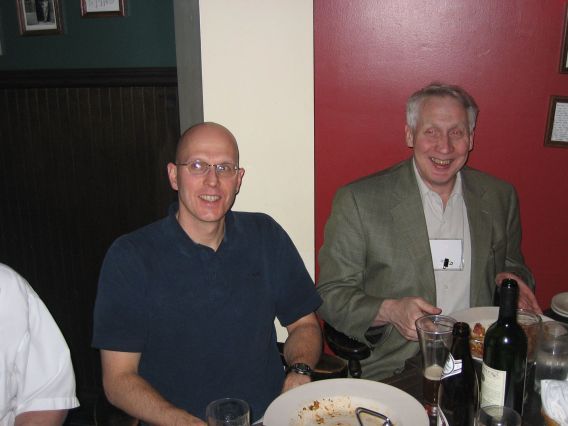
Mylan Engel Jr, whom I have known for more than 20 years, has accepted my invitation to join this blog. Mylan (on the left in this image) is Associate Professor of Philosophy (with tenure) at Northern Illinois University in DeKalb, Illinois. We met in graduate school at The University of Arizona. There is a link to Mylan's homepage on the left, in the Members area. You may also want to read his essay, "The Immorality of Eating Meat," a link to which appears (where else?) in the Links area. It is the best essay I've ever read on the moral status of nonhuman animals. Please spread the word about this blog. I hope Mylan's presence gives it new life.
Addendum: Mylan and I are committed to protecting the interests of nonhuman animals. You could say that we're animal liberationists. Perhaps it would be nice if I added someone who thinks the interests of animals may be discounted or disregarded. But Mylan and I are far from clones. I'm politically conservative; Mylan is a liberal. I'm a moral subjectivist; Mylan is an objectivist. I'm an egoist; Mylan is an altruist. I'm a dog lover; Mylan is a cat lover. I'm a demi-vegetarian; Mylan is a vegan. I think epistemology is dead; Mylan thinks it's alive and well. I hope our differences make for an interesting blog!
02 March 2005
Don't Get on the Wrong Side of Bessie
See here. (Thanks to my bird-loving [but meat-eating] friend Peg Kaplan for the link.)
Addendum: See here.
26 February 2005
Paul W. Taylor on Biocentrism
When a life-centered view is taken, the obligations and responsibilities we have with respect to the wild animals and plants of the Earth are seen to arise from certain moral relations holding between ourselves and the natural world itself. The natural world is not there simply as an object to be exploited by us, nor are its living creatures to be regarded as nothing more than resources for our use and consumption. On the contrary, wild communities of life are understood to be deserving of our moral concern and consideration because they have a kind of value that belongs to them inherently. Just as we would think it inappropriate to ask, What is a human being good for? because such a question seems to assume that the value or worth of a person is merely a matter of being useful as a means to some end, so the question, What is a wilderness good for? is likewise considered inappropriate from the perspective of a biocentric outlook. The living things of the natural world have a worth that they possess simply in virtue of their being members of the Earth’s Community of Life. Such worth does not derive from their actual or possible usefulness to humans, or from the fact that humans find them enjoyable to look at or interesting to study.
(Paul W. Taylor, Respect for Nature: A Theory of Environmental Ethics [Princeton: Princeton University Press, 1986], 12-3)
Subscribe to:
Posts (Atom)